
PSLE#9 English Oral - Every Drop Counts: Our Water Story
PSLEhacker Episode #9 - PEEL Method

Date of News Article: 22 February 2026 Source: Adapted from The Straits Times (Environment & Sustainability)
Reading Passage:
Singapore, a small island nation, has always understood the preciousness of water. Our journey from relying solely on imported water to developing our own sustainable sources like NEWater and desalinated water is a testament to our resilience. However, the fight for water security isn’t over. With climate change leading to more extreme weather patterns, water conservation remains a top national priority.
Recent reports from the Public Utilities Board (PUB) indicate that while household water consumption has seen a slight decrease, there’s still room for improvement. The target is to reduce daily per capita water consumption from 141 litres today to 130 litres by 2030. Every drop saved contributes to our collective future.
Schools across Singapore are actively involved in this effort. During “Water Week” events, students learn about the importance of reducing, reusing, and recycling water. Simple acts like taking shorter showers, turning off the tap while brushing teeth, and checking for leaky faucets are emphasized. These small changes, when adopted by every household, can lead to significant savings.
Beyond individual actions, technology plays a vital role. Smart water meters are being piloted in various estates, providing real-time data to help residents monitor and manage their water usage more efficiently. Communities are also organizing “Rainwater Harvesting” workshops, where residents learn to collect rainwater for gardening, reducing reliance on treated water.
Ultimately, water conservation is a shared responsibility. It requires every Singaporean to be a “Water Steward”—someone who actively protects and manages our water resources. By embracing a “Water-Smart” mindset, we not only ensure a sustainable future for ourselves but also for generations to come.
Word Count: 295 words
(B) Stimulus-Based Conversation (SBC):
Question & Answer
Question 1: Visual Stimulus
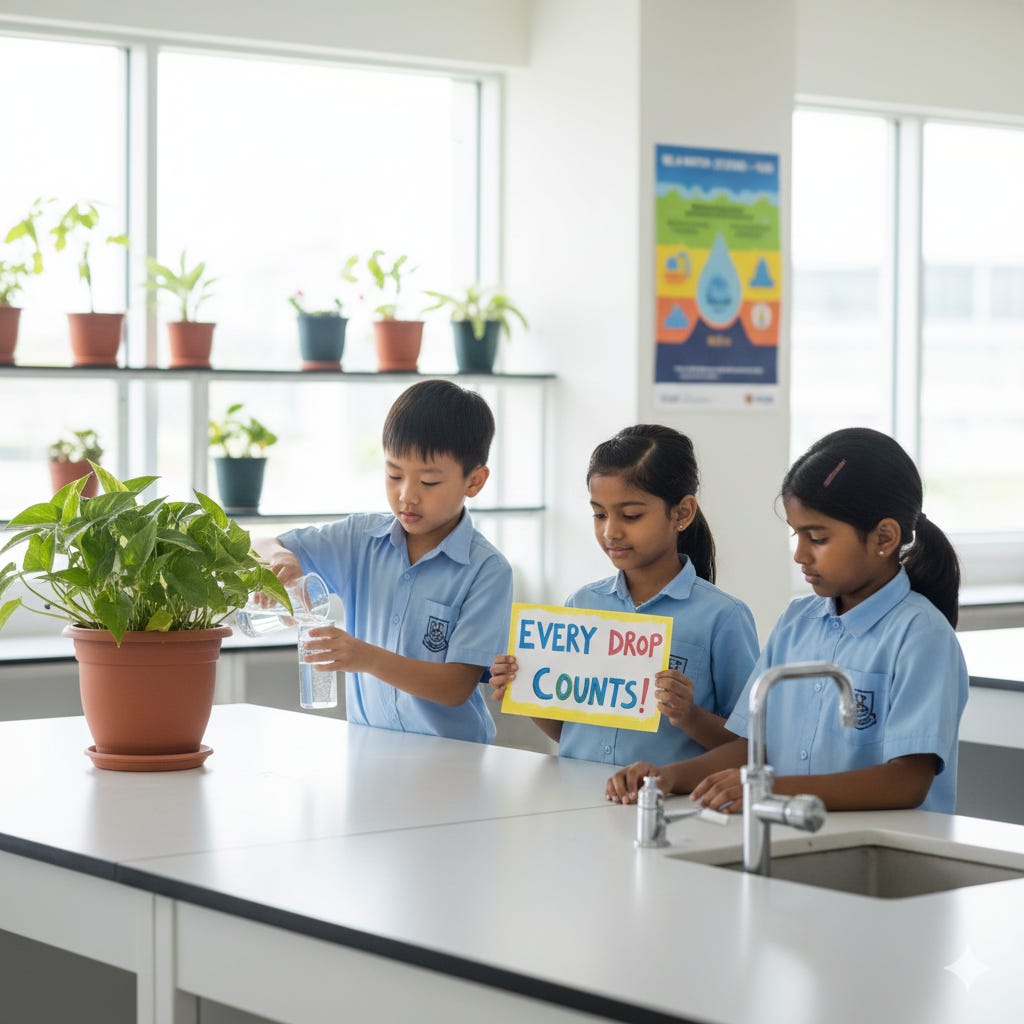
“Look at the picture. What is the boy doing, and why is this action important?”
Point: The boy is demonstrating excellent water conservation habits by reusing water for plants instead of wasting it.
Explanation: He understands that even clean, leftover water from an experiment can serve another purpose, which is to nourish the plants. This simple act reduces overall water wastage in the school.
Example/Experience: The boy has a supportive smile and a gentle gaze of reassurance as he pours the water, showing he feels a deep sense of accomplishment and pride in his actions. It reminds me of my own Science class, where our teacher inculcated in us the habit of collecting rinse water to water the school’s butterfly garden.
Link: This small meaningful and wise choice helps to move the needle toward making our school more “Water-Smart.”
Question 2: Personal Experience
“How do you and your family practice water conservation at home?”
Point: My family and I are very environmentally-conscious and try our best to save water in our daily routines.
Explanation: We understand that every drop counts, so we always look for ways to reduce our water footprint.
Example/Experience: For instance, we always take shorter showers, and my mother reuses the water from washing rice to water her potted plants. My father is also very diligent about checking for leaky faucets. Just last month, he fixed a dripping tap in the kitchen, which made me feel a deep sense of accomplishment and pride in his resourcefulness.
Link: These small, fun-filled habits have helped to forge a strong sense of camaraderie within my family, as we all play our part in being “Water Stewards.”
Question 3: Solution-Based / National Resilience
“Beyond our own homes, how can we encourage the wider community to be more ‘Water-Smart’?”
Point: I believe that education through community events and the use of technology are the most effective ways to move the needle toward a more water-conscious society.
Explanation: Many people waste water simply because they do not realize how much they are using. By organizing meaningful and supportive workshops at Community Clubs, we can inculcate better habits in our neighbors.
Example/Experience: For example, my neighborhood recently held a “Water Stewardship” fair where they showed us how to install smart water meters. Seeing the real-time data made my neighbors realize that small changes, like turning off the tap while soaping dishes, lead to a deep sense of accomplishment and pride when the monthly bill arrives. It really helped to forge a sense of camaraderie among us as we all shared tips on saving water.
Link: If the whole community takes proactive steps, we can ensure that Singapore’s “Water Story” remains one of success and resilience.
Continue reading at your free time ……………….
Theme: Environmental Protection / Water Conservation Visual Stimulus: A bright, clean photo of a student in a school uniform, standing at a sink in a science lab. He is carefully pouring leftover water from a beaker into a plant pot, rather than down the drain. There are other plants on a nearby shelf.
📖 Vocabulary List
Resilience (Noun): The capacity to recover quickly from difficulties; toughness.
Desalinated Water (Noun): Water that has had its salt and other minerals removed.
Per Capita (Adjective/Adverb): For each person; per head.
Steward (Noun): A person who manages another’s property or financial affairs; one who has charge of something. (Here, “Water Steward” means someone who protects water resources).
Footprint (Noun): The impact of a person or community on the environment. (e.g., “water footprint”).
🌟 Idiom of the Day
“Every drop counts”
Meaning: Even a small amount or effort is important and makes a difference.
PSLE Oral Usage: “My teacher always reminds us that when it comes to saving water, every drop counts, so we should always turn off the tap completely after washing our hands.”