
PSLE#7 English Oral - Small Acts, Big Smiles: Graciousness on the Go
PSLEhacker Episode 7 - PEEL Method

Date of News Article: 18 February 2026 Source: Adapted from The Straits Times (Transport & Urban Life)
Reading Passage:
Singapore’s public transport network is the backbone of our city, with millions of commuters traveling on buses and trains every day. To make these journeys more pleasant, the Land Transport Authority (LTA) has refreshed its “Greatness in Graciousness” campaign. This year, the focus is on three simple yet impactful behaviors: giving up seats to those in need, moving to the rear of the bus, and waiting for others to alight before boarding.
Recent observations show that while most Singaporeans are law-abiding, “commuter fatigue” can sometimes lead to a lack of awareness. To combat this, “Graciousness Ambassadors” have been deployed at busy interchange stations like Jurong East and Tampines. These ambassadors don’t just give reminders; they also hand out small tokens of appreciation to commuters caught performing “random acts of kindness,” such as helping a parent with a stroller or alerting a fellow passenger who dropped their EZ-Link card.
Transport officials emphasize that a little empathy goes a long way in a crowded environment. For instance, removing a backpack and placing it on the floor creates more standing room for others, especially during the peak hour rush. Similarly, keeping volume levels low on mobile devices shows respect for the shared space of others.
The campaign also highlights the importance of the “Yellow Zone”—the area near the doors. By keeping this area clear, commuters ensure that boarding and alighting are smooth and safe for everyone. Ultimately, graciousness is not about following a set of strict rules; it is about cultivating a “heart-ware” for our community. When we choose to be considerate, we transform a mundane commute into a more harmonious and supportive experience for all.
Word Count: 288 words
(B) Stimulus-Based Conversation (SBC):
Q&A Time :
Question 1: Visual Stimulus
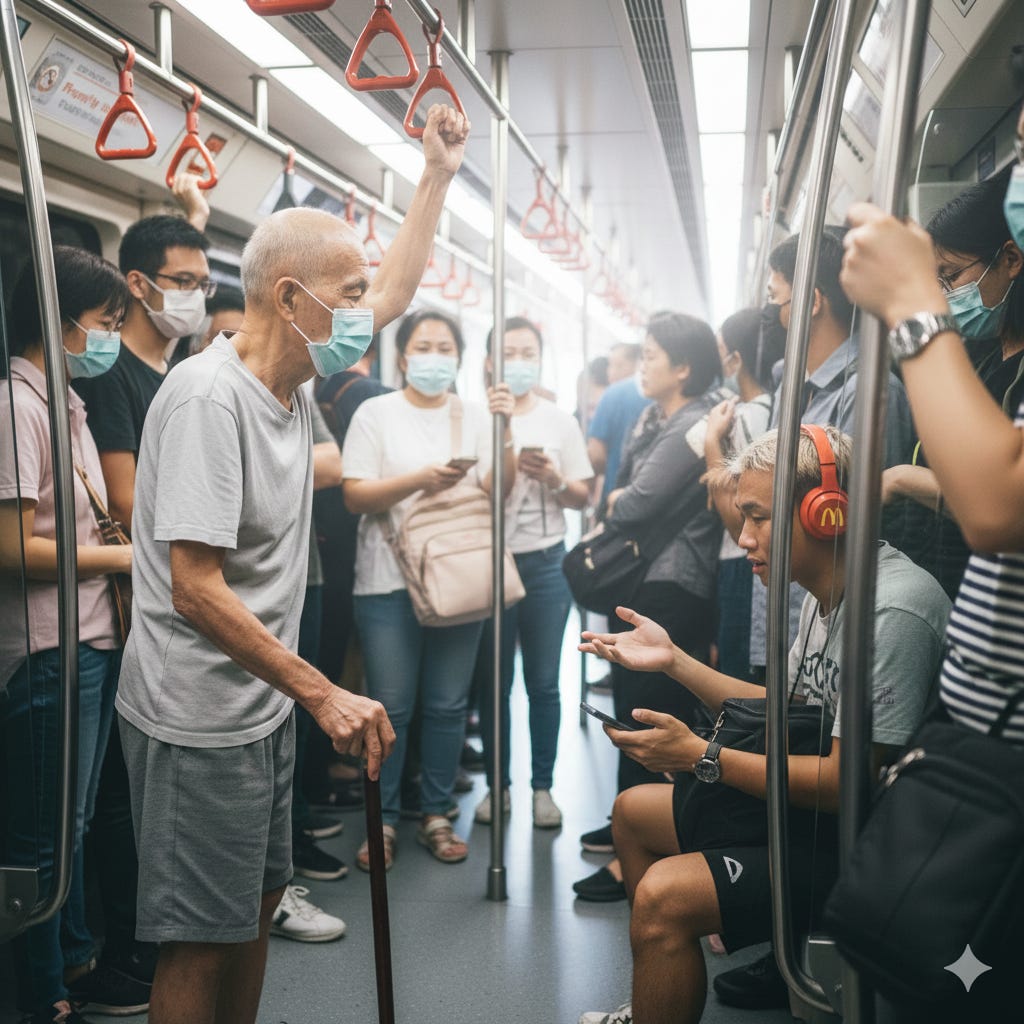
“Look at the picture. Describe the situation and how you think the elderly man feels.”
Point: The picture depicts a crowded MRT train where an elderly man with mobility needs is forced to stand because no one has offered him a seat.
Explanation: Despite having a walking stick, he has to balance himself in a moving train. This is not only tiring but also dangerous for someone of his age.
Example/Experience: The elderly man has a supportive smile and a gentle gaze of reassurance as he tries to stay steady, but I believe deep down he feels a sense of vulnerability. In contrast, the young man seated looks like a picture of concentration on his phone, seemingly unaware of the senior’s presence. It reminds me of a time I saw a similar situation at Serangoon MRT; the train was bustling and everyone seemed to have their eyes glued to their screens.
Link: It is a clear example of “bystander effect,” where people are too deeply engrossed in their own worlds to notice those who need a lending hand.
Question 2: Personal Opinion
“In your opinion, why do some commuters hesitate to offer their seats to those in need?”
Point: I think there are two main reasons: digital distraction and the fear of awkwardness.
Explanation: Many people are not intentionally unkind; they are simply at the end of their tether after a long day and use their phones to “zone out.” Others might feel a sense of apprehension—they worry that if they offer a seat, the person might feel insulted or decline it, making the situation awkward.
Example/Experience: I once saw a student try to offer a seat, but the senior politely declined. The student looked a bit embarrassed. However, my teacher taught us that we should ‘byte the bullet’ and offer anyway. It is better to be politely declined than to ignore someone who is struggling to stand.
Link: Therefore, we need to inculcate a culture where offering help is the “normal” thing to do, rather than something we feel shy about.
Question 3: Solution-Based
“What can be done to encourage more ‘heart-ware’ among commuters in Singapore?”
Point: I believe we need a combination of “nudge” technology and early education.
Explanation: The government has already made great strides by installing “Give Up Your Seat” stickers, but perhaps we can use apps that send a gentle notification when a person with a “Priority” tag enters the train. More importantly, schools should continue to forge a sense of camaraderie and compassion by sharing these real-life stories.
Example/Experience: In my school, we have “Values-in-Action” projects where we put ourselves in someone else’s shoes. We practiced walking with a stick to understand how difficult it is to balance. This was a mutually rewarding experience because it made us more alert to the needs of others.
Link: If we start young, we can move the needle toward a society that is not just “Smart” but also “Heart.”
Continue when you got the spare energy to give ……………….
Theme: Graciousness / Public Transport Etiquette Visual Stimulus: A bright, daytime photo of a crowded MRT cabin. An elderly man with a walking stick and a face mask is standing, holding onto a handrail. A younger man with headphones is seated nearby, looking up from his phone with an uncertain expression while other commuters are distracted by their devices.
Look for “Clues” in the picture:
Facial Expressions: Are they smiling, frowning, or blank?
Body Language: Are they leaning, sitting, or struggling?
Objects: Are there signs (No Eating), tools (Walking stick), or distractions (Phones)?
🌟 Idiom of the Day
“Turn a blind eye”
Meaning: To pretend not to notice something that is happening, usually because you don’t want to help or get involved.
PSLE Oral Usage: “We should never turn a blind eye to the elderly standing on the bus; instead, we should be proactive and offer our seats immediately.”
📖 Vocabulary List
Vulnerability (Noun): The state of being exposed to the possibility of being attacked or harmed, either physically or emotionally.
Inattentional Blindness (Phrase): When a person fails to notice an unexpected stimulus that is in plain sight because they are focused on something else (like a phone).
Proactive (Adjective): Creating or controlling a situation by causing something to happen rather than responding to it after it has happened.
Bustling (Adjective): Full of energetic and noisy activity.
Reassurance (Noun): The action of removing someone’s doubts or fears.