
PSLE#41 English Oral– Beyond the Books: The Power of Arts CCAs
PSLEhacker Episode #41 - OREO Method

Date of News Article: 20 Jan 2026 Source: Adapted from School Heritage and Arts Features
Reading Passage:
As the school term progresses, the familiar sounds of ringing triangles, harmonious singing, and rhythmic dance steps echo through the school halls late into the afternoon. Across Singapore, students in Performing Arts CCAs are pouring hours of effort into rehearsing for upcoming showcases and the highly anticipated Singapore Youth Festival (SYF) Arts Presentation.
While academics remain a priority, the Ministry of Education strongly emphasizes a holistic education. Arts and Cultural CCAs are no longer seen as just “hobbies” or a way to pass the time; they are recognized as indispensable platforms for character building. When fifty students in a concert band learn to play their distinct instruments in perfect harmony, they are not just making music. They are learning the true meaning of synergy and discipline.
The journey to the stage is rarely easy. It requires students to be highly proactive in managing their time between homework and rigorous practices. There are times when students feel exhausted or frustrated by a difficult routine. However, by choosing to weather the storm and push through these challenges together, they forge a strong sense of camaraderie that often lasts long after graduation.
Ultimately, joining an Arts CCA is a meaningful and wise choice. It provides a creative outlet for students to express their emotions and relieves the stress of a demanding syllabus. By doing their part and stepping onto the stage with confidence, our youths prove that true success in school goes far beyond the grades on a report card.
Word Count: 285 words
PSLE Oral Practice: Stimulus-Based Conversation (Advanced O.R.E.O.)
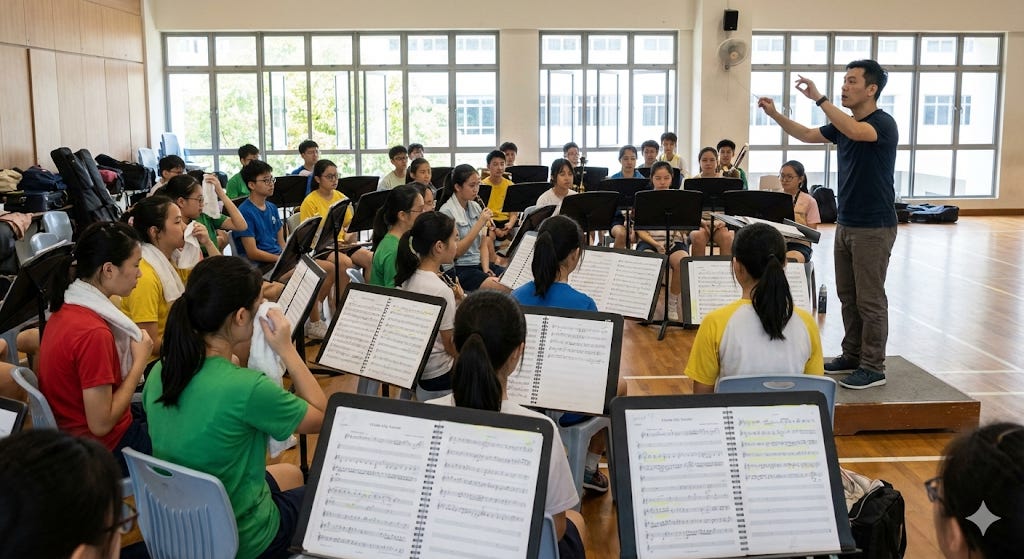
Question 1: Visual Description & Analysis
“Look at the picture. Describe the atmosphere of this practice session and explain what values these students are learning.”
O (Opinion): In my opinion, the atmosphere is intensely focused and disciplined, showing that the students are deeply committed to perfecting their craft.
R (Reason): The pencil notes on their sheet music tell me that they are being proactive in correcting their mistakes. Even though they look tired, they are keeping their eyes glued to the conductor. This activity teaches them the value of resilience and synergy, as every single instrument must be perfectly timed to create a beautiful song.
E (Experience): In my own CCA, I know how grueling long practice sessions can be, especially after a long day of lessons. However, when we finally master a difficult piece together, it gives us a deep sense of reassurance and pride. We learn that nobody can succeed alone.
O (Opinion Restated): Therefore, the dedication shown in this picture proves that Arts CCAs are an indispensable tool for learning teamwork.
Question 2: Personal Reflection
“What CCA are you in, and how has it helped you grow as a person?” (Note for Joyze/Jayze/Jayne: You can adapt this to your actual CCA!)
O (Opinion): I am in the [Insert CCA, e.g., Art Club / Choir], and I feel that it has completely transformed me into a more confident and patient person.
R (Reason): Before I joined, I used to give up easily when things got difficult. My CCA taught me that masterpieces take time and constant refinement. It showed me that making mistakes is just a part of the learning process, not a reason to quit.
E (Experience): For instance, during the preparation for our school’s Arts Fiesta last year, our team had a major disagreement over our performance piece. Instead of arguing, we made the meaningful and wise choice to sit down and listen to everyone’s ideas. Navigating that conflict helped us forge a strong sense of camaraderie, and our final project was a huge success.
O (Opinion Restated): Ultimately, my CCA has equipped me with the resilience to weather the storm of any challenge I face.
Question 3: Solution-Based (Parental Concerns)
“Some parents feel that CCAs take up too much time and distract students from their studies. How would you convince them otherwise?”
O (Opinion): I would respectfully explain to them that while CCAs do take up time, they actually enhance a student’s academic journey rather than distract from it.
R (Reason): Studying non-stop can lead to extreme burnout. An Arts CCA provides a vital mental break and an outlet for creative expression. More importantly, juggling both forces a student to be highly proactive in managing their time efficiently.
E (Experience): I use a physical planner to block out my time for homework and CCA practices. Knowing I have CCA after school makes me more focused during my study blocks because I cannot afford to procrastinate. My parents see that I am developing discipline, which gives them a deep sense of reassurance.
O (Opinion Restated): Therefore, balancing both academics and a CCA is a meaningful and wise choice that develops a well-rounded and successful student.
Theme: School Life / CCAs (Culture & Art) / Resilience and Teamwork Visual Stimulus: A photo of a school’s Chinese Orchestra or Symphonic Band practicing in the school hall. The students look tired but highly focused as they watch their conductor, whose arms are raised. Several students have their sheet music covered in pencil notes.
🌟 Mastery Vocabulary List
Holistic: Dealing with or treating the whole of something or someone and not just a part (e.g., caring about character, not just grades).
Synergy: The combined power of a group of things when they are working together that is greater than the total power achieved by each working separately.
Rigorous: Extremely thorough, exhaustive, or accurate (describing tough practices).
Procrastinate: To delay or postpone action; put off doing something.
Refinement: The process of removing impurities or making small changes to improve something.