
PSLE#37 English Oral – Sweaters in Singapore: Adapting to Unpredictable Weather
PSLEhacker Episode #37 - OREO Method

Date of News Article: 20 February 2026 Source: Adapted from Meteorological Service Singapore (MSS) & Local News
Reading Passage:
Singaporeans have recently swapped their usual short sleeves for thick jackets and scarves. Thanks to an active monsoon surge in February 2026, the island has experienced relentless rain and uncharacteristically chilly winds, with temperatures dropping to a cool 22°C in several areas. For a tropical nation accustomed to year-round humidity, this sudden “sweater weather” has been a shock to the system.
While many youths are enjoying the air-con-like weather, experts warn that these unpredictable temperature drops are a symptom of broader global climate change. Weather patterns are becoming increasingly erratic, meaning we can expect more extreme heavy downpours and sudden cold snaps in the future.
This drastic change in weather requires us to be highly proactive. Health professionals are advising the public to stay warm and dry, as the sudden chill can easily lead to the flu, especially among the more frail members of our community, such as the elderly.
Beyond personal health, this is a time that calls for strong civic-mindedness. Whether it is sharing an umbrella with someone caught in the rain, or checking in on a senior neighbor to ensure their floors aren’t dangerously slippery, small acts of kindness are indispensable. By looking out for one another, we can make the meaningful and wise choice to ensure everyone stays safe, no matter how unpredictable the skies become.
Word Count: 285 words
PSLE Oral Practice: Stimulus-Based Conversation (Advanced O.R.E.O.)
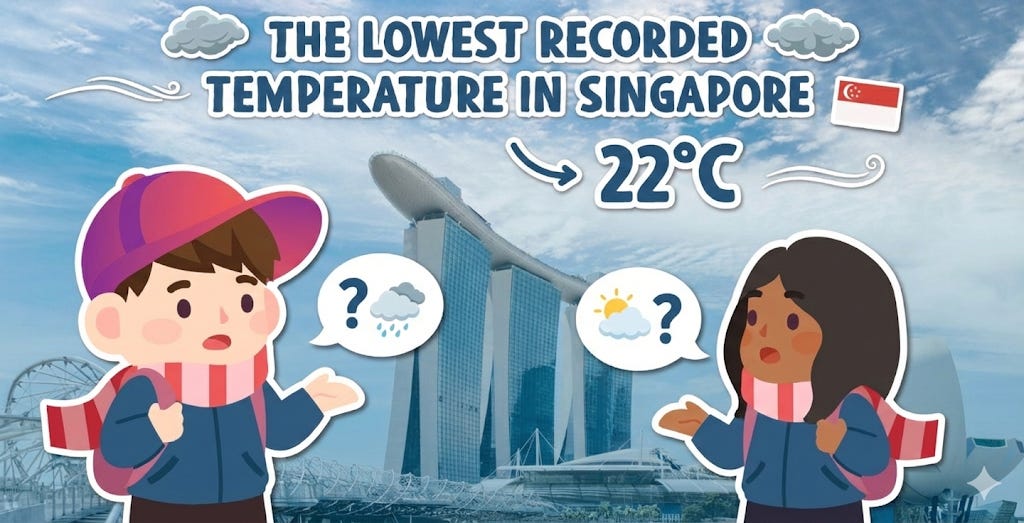
Question 1: Visual Analysis
“Look at the picture. How are the students reacting to the weather, and what does this tell us about Singapore’s climate?”
O (Opinion): The students appear quite surprised and are heavily bundled up, which highlights how unusual and unpredictable Singapore’s tropical climate has become.
R (Reason): Normally, students in Singapore wear light uniforms. Seeing them in thick scarves for 22°C shows that we are not naturally accustomed to cold weather. The question marks above their heads indicate that the weather is fluctuating constantly between rain and shine, making it hard to plan the day.
E (Experience): Just this morning, it was sunny when I left the house, but it started pouring heavily during recess. Thankfully, my parents always remind me to make a proactive choice by packing a small umbrella and a jacket in my bag. This gives me a deep sense of reassurance that I won’t fall sick.
O (Opinion Restated): Therefore, being prepared for sudden weather changes is a meaningful and wise choice for every student today.
Question 2: Personal Reflection & Empathy
“During such cold and heavy downpours, how can we show care for the more vulnerable people in our community?”
O (Opinion): We must demonstrate strong civic-mindedness by paying closer attention to the elderly and those who might struggle during harsh weather.
R (Reason): While youths might enjoy the cool breeze, heavy rain makes walkways slippery and dangerous for pioneers who are frail. If we are oblivious to their struggles, they could easily fall or catch a severe cold.
E (Experience): Last evening, the rain was blowing into the HDB corridors. I helped my elderly neighbor pull her laundry racks inside and close her windows. She was very grateful. It made me realize that if we all do our part, we can help each other literally and metaphorically weather the storm.
O (Opinion Restated): Ultimately, checking in on our neighbors is an indispensable habit that keeps our community safe and warm.
Question 3: Global/Future Perspective
“Scientists say extreme weather will become more common due to climate change. What can students do to help protect the environment?”
O (Opinion): I believe students must actively reduce our carbon footprint by adopting sustainable daily habits to combat climate change.
R (Reason): The erratic “sweater weather” is a warning sign that the earth is out of balance. If we continue to waste resources, these unpredictable monsoons will only worsen, leading to floods and environmental disasters.
E (Experience): In school, our teachers inculcate the importance of the 3Rs: Reduce, Reuse, and Recycle. For example, instead of buying a new plastic bottle every day, I use a reusable flask. I also remind my family to switch off the air-conditioner, especially when the weather is already so cool outside! This helps us forge a strong sense of camaraderie as a family working toward a green goal.
O (Opinion Restated): Making the meaningful and wise choice to protect the earth today is the only way to ensure a stable climate for our future.
Theme: Environment / Empathy / Preparedness Visual Stimulus: An informative graphic showing Marina Bay Sands in the background. In the foreground, two students bundled up in winter scarves and jackets are looking surprised while discussing the weather. A large text bubble shows the temperature at 22°C with icons of rain clouds and an uncertain sun.
🌟 Mastery Vocabulary List (Post #37)
Unpredictable: Not able to be foreseen or known beforehand.
Erratic: Not even or regular in pattern or movement.
Frail: Weak and delicate (often used to describe the elderly respectfully).
Oblivious: Not aware of what is happening around you.
Civic-mindedness: The habit of caring about your community and actively helping others.