
PSLE#36 English Oral– My Money, My Responsibility: The Rise of Kids’ Debit Cards
PSLEhacker Episode #36 - OREO Method

Date of News Article: 20 December 2025 Source: Adapted from OCBC Bank Newsroom & The Straits Times (Personal Finance)
Reading Passage:
In 2026, the way Singaporean children manage their pocket money is undergoing a digital transformation. OCBC Bank recently expanded its “MyOwn Account,” allowing children as young as seven to have a bank account in their own name and a personalized debit card. These cards, featuring popular designs like Disney and Marvel, allow students to make cashless payments at school canteens, bookstores, and even online.
While these cards offer convenience, they come with a significant “learning curve.” To ensure safety, parents can set daily spending limits and use a “Money Lock” feature to protect savings from digital scams. Financial experts suggest that giving children their own debit cards is an excellent way to inculcate the habit of budgeting from an early age.
However, possessing a debit card is a “double-edged sword.” Without proper guidance, children might become oblivious to how quickly their balance depletes. Therefore, parents are encouraged to use the “mirrored dashboard” on their banking apps to monitor transactions and discuss spending habits with their children.
Ultimately, making the meaningful and wise choice to save rather than spend is a skill that will be indispensable for the future. By being proactive in learning about digital finance today, our youths can weather the storm of future economic challenges with confidence.
Word Count: 295 words
PSLE Oral Practice: Stimulus-Based Conversation (Advanced O.R.E.O.)
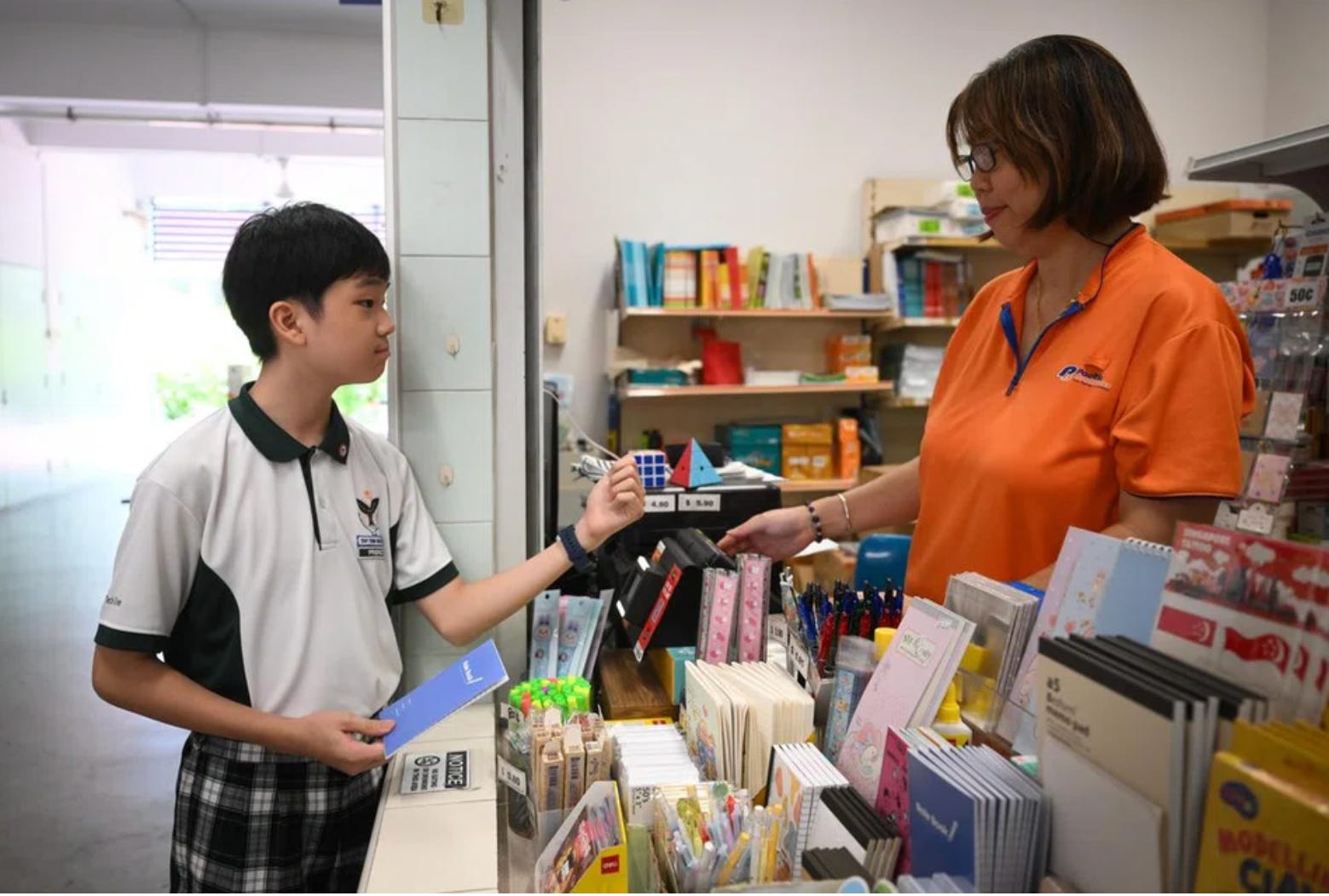
Question 1: Visual Description & Analysis
“Look at the picture. Describe what the student is doing and explain why this has become a common sight in schools today.”
O (Opinion): I believe the student is making a convenient, cashless payment for his stationery using a smart device or a student debit card.
R (Reason): As Singapore progresses towards becoming a Smart Nation, many schools have adopted digital payment terminals at bookshops and canteens. It speeds up the queues and removes the hassle of counting small coins or losing physical cash.
E (Experience): In my own school, using a digital card or a smart watch to pay for food and books is the norm. It gives me a deep sense of reassurance knowing that my pocket money is stored safely digitally. I don’t have to worry about dropping my coins while running on the field.
O (Opinion Restated): Therefore, transitioning to cashless payments in school is a meaningful and wise choice that helps students adapt to modern technology.
Question 2: Personal Opinion (Needs vs. Wants)
“When you have your own digital allowance or debit card, how do you manage your spending to ensure you don’t run out of money?”
O (Opinion): I feel that having a digital allowance requires me to be highly proactive in distinguishing between my “needs” and my “wants.”
R (Reason): The danger of a debit card is that it is very easy to become oblivious to how much money is actually leaving your account. Since you are just “tapping” instead of handing over physical notes, you might accidentally overspend on snacks or fancy stationery.
E (Experience): I once tapped my card to buy several expensive pens just because they looked nice. A few days later, I didn’t have enough balance to buy a file I actually needed for my project! I had to byte the bullet and admit my mistake to my parents. Since then, I always make sure to prioritize my school necessities first.
O (Opinion Restated): Thus, practicing self-discipline and budgeting is an indispensable skill when using digital money.
Question 3: Solution-Based (Parental Guidance)
“What are some ways parents can guide their children to use debit cards responsibly without taking away their independence?”
O (Opinion): I think the best approach is for parents to use digital tools to set healthy boundaries, such as daily spending limits.
R (Reason): By setting a limit, parents protect their children from losing large sums of money if the card is misplaced, while still giving the child the freedom to decide what to buy within that budget.
E (Experience): My parents have access to a “mirrored dashboard” on their banking app where they can see my transactions. If they notice I’m spending too much at the bookshop, we sit down and talk about it. This open communication helps forge a strong sense of camaraderie and trust. They also taught me how to use the “Kill Switch” to freeze my card if I ever lose it.
O (Opinion Restated): Ultimately, a parent’s active and proactive guidance is the most meaningful and wise choice to keep students financially secure.
Topic: Cashless Payments & Financial Responsibility in School
Visual Stimulus: A student in a school uniform purchasing a blue notebook at the school bookshop. He is extending his arm to make a cashless payment (using a card or smart watch) on the terminal, while the bookshop auntie looks on.
🌟 Mastery Vocabulary for this Image:
Transaction: An instance of buying or selling something.
Oblivious: Not aware of or not concerned about what is happening around one.
Prioritize: To treat something as being more important than other things.
Convenience: The state of being able to proceed with something with little effort or difficulty.