
PSLE#35 English Oral – Digital Gold or Digital Gamble? Understanding Bitcoin
PSLEhacker Episode #35 - OREO Method

Date of News Article: 20 February 2026 Source: Adapted from The Business Times & MAS Advisory
Reading Passage:
Bitcoin, often called “digital gold,” has once again captured the headlines in Singapore. After peaking at a staggering US$126,000 in October 2025, the original cryptocurrency has entered a relentless “freefall,” touching lows of US$60,000 this February. This drastic price swing has wiped out nearly US$2 trillion in value from the broader crypto market, serving as a brutal reminder of the risks involved in speculative trading.
In response to this volatility, Singapore’s leaders have reiterated that cryptocurrencies are not legal tender and lack fundamental value. MAS has even prohibited crypto platforms from offering credit or leverage to retail customers to prevent them from falling into compounding debt. Despite these risks, institutional interest remains high, with major banks like DBS launching digital asset exchanges for accredited investors.
For the average citizen, the meaningful and wise choice is to view such assets with extreme caution. Financial experts suggest that a well-informed mind is the best defense against the “fear of missing out” (FOMO). By inculcating a habit of researching the intrinsic value of an investment rather than following online hype, we take a proactive step toward long-term financial stability. In the world of finance, patience and discernment are indispensable virtues.
Word Count: 310 words
PSLE Oral Practice: Stimulus-Based Conversation (Advanced O.R.E.O.)
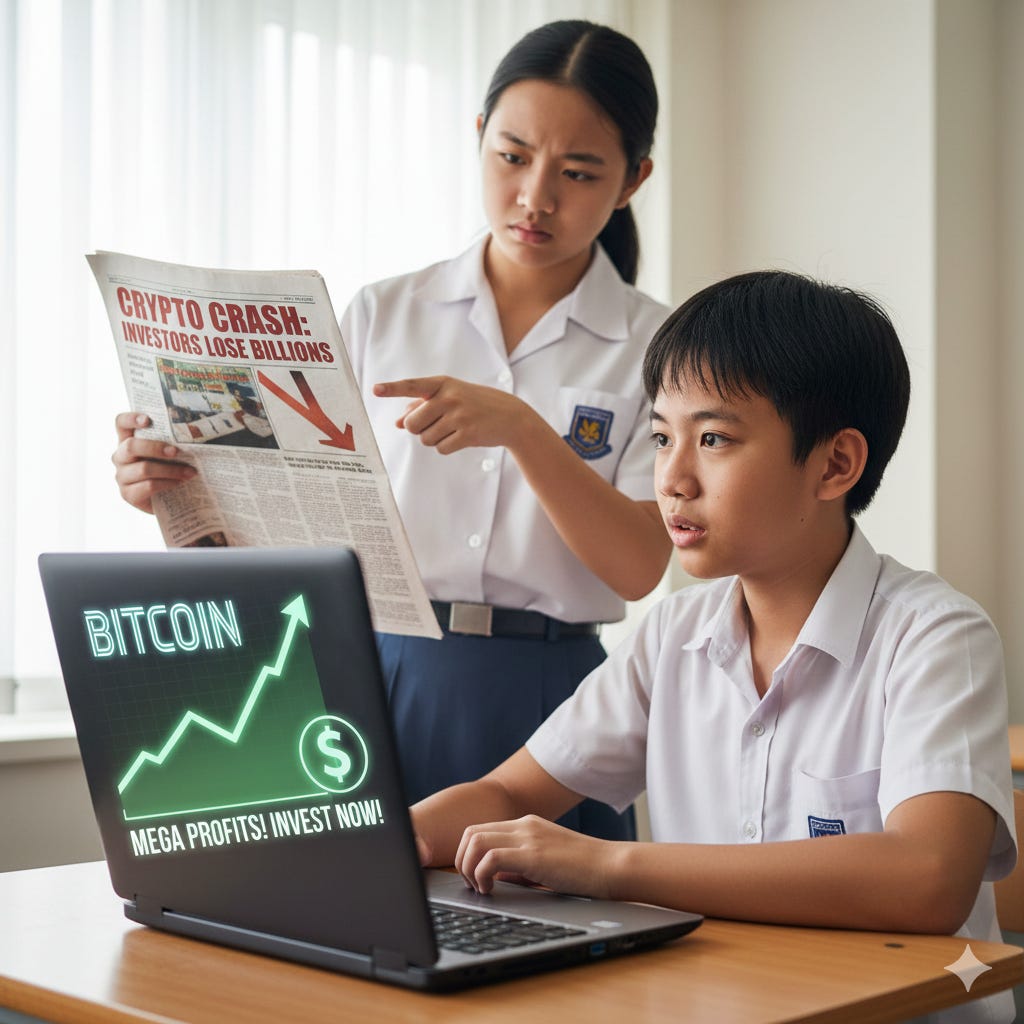
Question 1: Visual Analysis
“Look at the picture. Why are the two characters reacting differently to the news about Bitcoin?”
O (Opinion): I believe the characters represent the conflict between “hype” and “reality,” with the student being lured by the excitement of gains while the sister serves as a voice of resilient caution.
R (Reason): The student is focused on the upward arrow, which often creates a “get-rich-quick” mindset. However, the sister is pointing to the “Crypto Crash” headline. She likely knows that while prices can soar, they can also drop by 45% or more in just a few months, leading to a detrimental loss of savings.
E (Experience/Evidence): In 2026, we’ve seen Bitcoin fall from its peak to nearly half its value. My parents always inculcate in me the importance of the “S.U.R.E.” method. Just because a “friend” or a social media influencer says an investment is “to the moon,” we must take it with a grain of salt.
O (Opinion Restated): Thus, the sister’s proactive warning is a meaningful and wise choice to prevent the student from making a rash financial mistake.
Question 2: Personal Opinion
“If you received a ‘Red Ang Bao’ with $50 for Chinese New Year, would you save it in a bank or try to ‘invest’ it in a digital asset? Why?”
O (Opinion): I would definitely choose to save it in a traditional bank account because I value financial security over high-risk speculation.
R (Reason): As MAS has warned, cryptocurrencies can lose their entire value overnight. For a student, losing $50 would be a detrimental blow to my savings. A bank account offers a deep sense of reassurance and even a small amount of interest without the risk of the money vanishing.
E (Experience): I have a savings goal for a new bicycle. By being proactive and putting my money in a bank, I am doing my part to reach that goal safely. I’ve seen news reports of people losing their life savings in crypto, and I don’t want to weather the storm of such a stressful situation.
O (Opinion Restated): Therefore, building a solid foundation through traditional banking is an indispensable habit for my future.
Question 3: Solution-Based
“How can schools better prepare students for a future where ‘digital money’ is everywhere?”
O (Opinion): I think schools should introduce “Financial Literacy Workshops” that teach students how to read market trends and identify the “red flags” of investment scams.
R (Reason): In our omnipresent digital world, students are constantly exposed to ads for crypto and trading apps. If we don’t inculcate the skills to differentiate between a “scam” and a “safe investment,” many youths might fall prey to misinformation.
E (Experience): If my school held a “Mock Trading” session where we could see how prices crash in a simulation, it would be a very eye-opening experience. It would help us forge a strong sense of camaraderie as we learn to protect our collective financial future.
O (Opinion Restated): By being proactive in education, we can ensure that Singapore remains a resilient and financially smart nation.
Theme: Financial Literacy / Risk Management / Critical Thinking : A drawing of a student looking at a laptop screen showing a bright green upward-trending arrow with the word “BITCOIN.” Behind him, an older sister is pointing at a newspaper headline that says “CRYPTO CRASH: INVESTORS LOSE BILLIONS.”
📖 Mastery Vocabulary List
Speculative (Adjective): Involving a high risk of loss in the hope of a large gain.
Intrinsic Value (Noun): The actual value of a company or an asset based on an underlying perception of its true value.
Volatility (Noun): The tendency of a substance (or in this case, a price) to change rapidly and unpredictably.
Accredited (Adjective): (Of a person or organization) officially recognized or authorized.
Legal Tender (Noun): Coins or banknotes that must be accepted if offered in payment of a debt.