
PSLE#29 English Oral– Hooked on the Future: Modernising Singapore’s Fish Farms
PSLEhacker Episode #29 - TREE Method

Date of News Article: 12 February 2026 Source: Adapted from The Straits Times (Food Security & Environment) Word Count: 295 words
Reading Passage:
For generations, traditional wooden kelongs have dotted the coastal waters of Singapore. These floating fish farms have long been a source of fresh seafood for the local community. However, as an island nation that imports over 90 per cent of its nutritional needs, Singapore faces a pressing challenge: how to ensure a stable food supply in a world affected by climate change and global supply chain disruptions.
To build resilience, the government introduced the “30 by 30” goal, aiming to produce 30 per cent of our nutritional needs locally by 2030. To achieve this, traditional fish farming methods are undergoing a massive high-tech transformation. Today, modern, closed-containment floating farms are replacing old wooden structures.
These advanced farms use technology to pump in filtered seawater, protecting the fish from sudden temperature changes, oil spills, and harmful algal blooms that frequently wipe out entire stocks in traditional open-net kelongs. By using automated feeding systems and solar panels, these modern facilities can yield up to ten times more fish, such as sea bass and grouper, in the same amount of space.
While the government provides grants to help farmers upgrade, the success of this initiative ultimately depends on consumers. Supermarkets now prominently display the red “SG Fresh Produce” logo to help shoppers identify local goods. By choosing to buy locally farmed fish, Singaporeans are taking a proactive step to support our farmers’ livelihoods. Making the meaningful and wise choice to eat local not only guarantees fresher food on our dining tables but also ensures that our nation remains self-reliant and prepared for the future.
PSLE Oral Practice: Stimulus-Based Conversation (TREE Method)
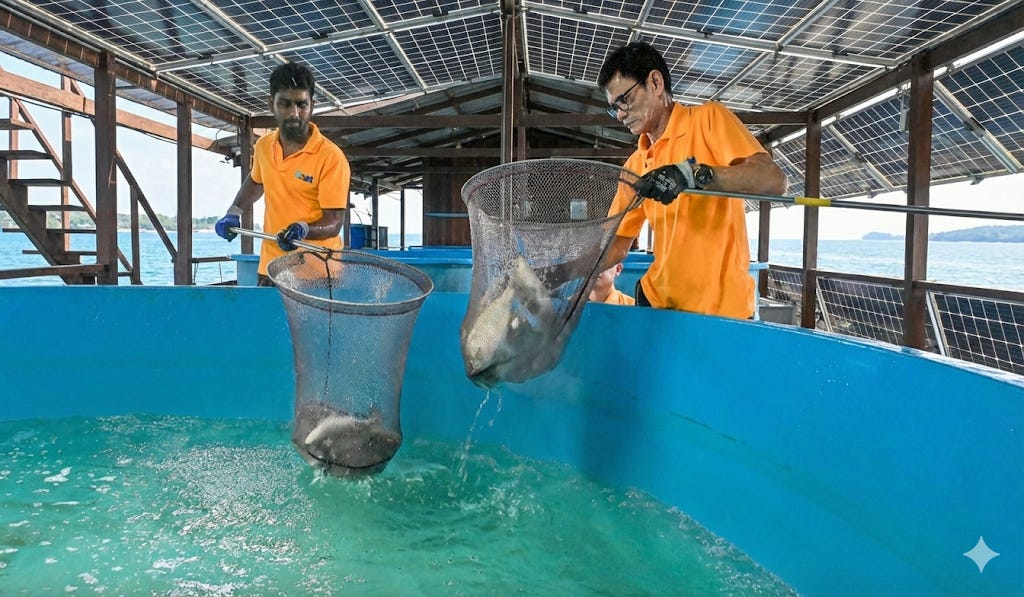
Question 1: Visual Stimulus
“Look at the picture. What is the worker doing, and why are such modern fish farms important for Singapore?”
Thought (T): The worker is proudly showing off a freshly harvested sea bass at a high-tech floating fish farm, which is a crucial facility for Singapore’s food security.
Reason (R): Because Singapore imports almost all of its food, we are very vulnerable to global shortages or delivery delays. Modern farms with solar panels and filtered water systems protect the fish from ocean pollution and changing weather, ensuring a steady supply of fresh seafood for our citizens.
Experience (E): In school, I learnt about the “30 by 30” goal during our Social Studies lesson. Knowing that we have the technology to grow our own food gives me a deep sense of reassurance. When I see local fish being sold at the supermarket, I feel proud of how far our local agriculture has come.
Ending (E): Therefore, investing in these modern farming methods is a wise choice to protect our nation against future food crises.
Question 2: Personal Opinion
“Does your family enjoy eating seafood, and do you actively look out for locally produced food when shopping? Share your experience.”
Thought (T): Yes, my family loves eating seafood, and we always try our best to support local farmers when we buy our groceries.
Reason (R): Locally farmed fish is much fresher because it does not need to be flown or shipped over long distances. Furthermore, supporting local businesses helps our farmers earn a living and stay in operation.
Experience (E): Whenever I follow my mother to the supermarket, she inculcates in me the habit of looking out for the bright red “SG Fresh Produce” sticker on the packaging. Just last week, we bought a locally farmed sea bass and steamed it for dinner. Sharing a delicious, fresh meal together helps to forge a strong sense of camaraderie in our family.
Ending (E): By being proactive in our shopping choices, we can do our part to contribute to Singapore’s food resilience.
Question 3: Solution-Based
“Besides buying their produce, how can schools encourage students to learn more about and appreciate the hard work of our local fish farmers?”
Thought (T): Schools can organize hands-on learning journeys to these kelongs or modern coastal farms.
Reason (R): Reading about aquaculture in textbooks can be quite dry. If students can see the actual physical effort required to feed and harvest the fish, they will develop a much deeper respect for the farmers and the food on their plates.
Experience (E): If my school organized a field trip to a modern fish farm, I would happily byte the bullet and endure the fishy smells just to experience it! Students could learn how to test the water quality or feed the fingerlings. Experiencing the farmers’ daily struggles first-hand would definitely make us less likely to waste food at the canteen.
Ending (E): Through immersive education, we ensure that the younger generation understands the value of our local food sources.
To be continue more…………….
Theme: Food Security / Sustainability / Heritage vs. Technology Visual Stimulus: A photo of a modern, high-tech floating fish farm off the coast of Singapore. A worker in waterproof gear is holding up a large, healthy, and freshly caught sea bass. In the background, solar panels are installed on the roof of the farm’s floating platform.
📖 Vocabulary List
Aquaculture (Noun): The rearing of aquatic animals or the cultivation of aquatic plants for food.
Resilience (Noun): The capacity to withstand or to recover quickly from difficulties; toughness (e.g., food resilience).
Yield (Verb/Noun): Produce or provide (a natural, agricultural, or industrial product); the amount produced.
Self-reliant (Adjective): Reliant on one’s own powers and resources rather than those of others.
Disruptions (Noun): Disturbances or problems which interrupt an event, activity, or process (e.g., supply chain disruptions).
🌟 Idiom of the Day
“Weather the storm”
Meaning: To successfully deal with a very difficult problem or survive a dangerous situation.
PSLE Oral Usage: “By producing our own food locally, Singapore will be able to weather the storm even if other countries stop exporting their food to us.”