
PSLE#25 English Oral – Caring for the Generation that Built Our Home
PSLEhacker Episode #25 - TREE Method

Date of News Article: 17 February 2026 (Based on the actual announcement by Health Minister Ong Ye Kung) Source: Adapted from The Straits Times & CNA (Health & Society)
Reading Passage:
As Singapore transitions into a “super-aged” society, the demand for eldercare services has grown exponentially. From nursing homes to active ageing centres, the unsung heroes meeting this demand are our community care workers. They provide vital intermediate and long-term care for seniors who require assistance with daily activities or continued medical attention after a hospital stay.
Recognising the heavy responsibilities these professionals bear, the Ministry of Health (MOH) recently announced a significant pay raise for the sector. By the end of 2026, approximately 23,000 community care staff will receive an annual salary increase of 7 per cent or more. To support this initiative, the government is providing an initial $100 million to help care organisations defray the higher manpower costs.
This timely move aims to narrow the salary gap between community care and acute hospital settings, ensuring that wages remain competitive. More importantly, it highlights the nation’s deep appreciation for this sector. Community care is physically and emotionally demanding, requiring immense patience and empathy to handle the complex needs of the elderly.
By improving remuneration, the government hopes to make healthcare a highly attractive career path. Schools and career fairs are now actively encouraging youths to consider joining the sector. Choosing to care for the generation that built our nation is a meaningful and wise choice. When we inculcate a culture that values and rewards our care workers, we take a proactive step in ensuring that our seniors will always be treated with the dignity and respect they deserve.
Word Count: 285 words
PSLE Oral Practice: Stimulus-Based Conversation (TREE Method)
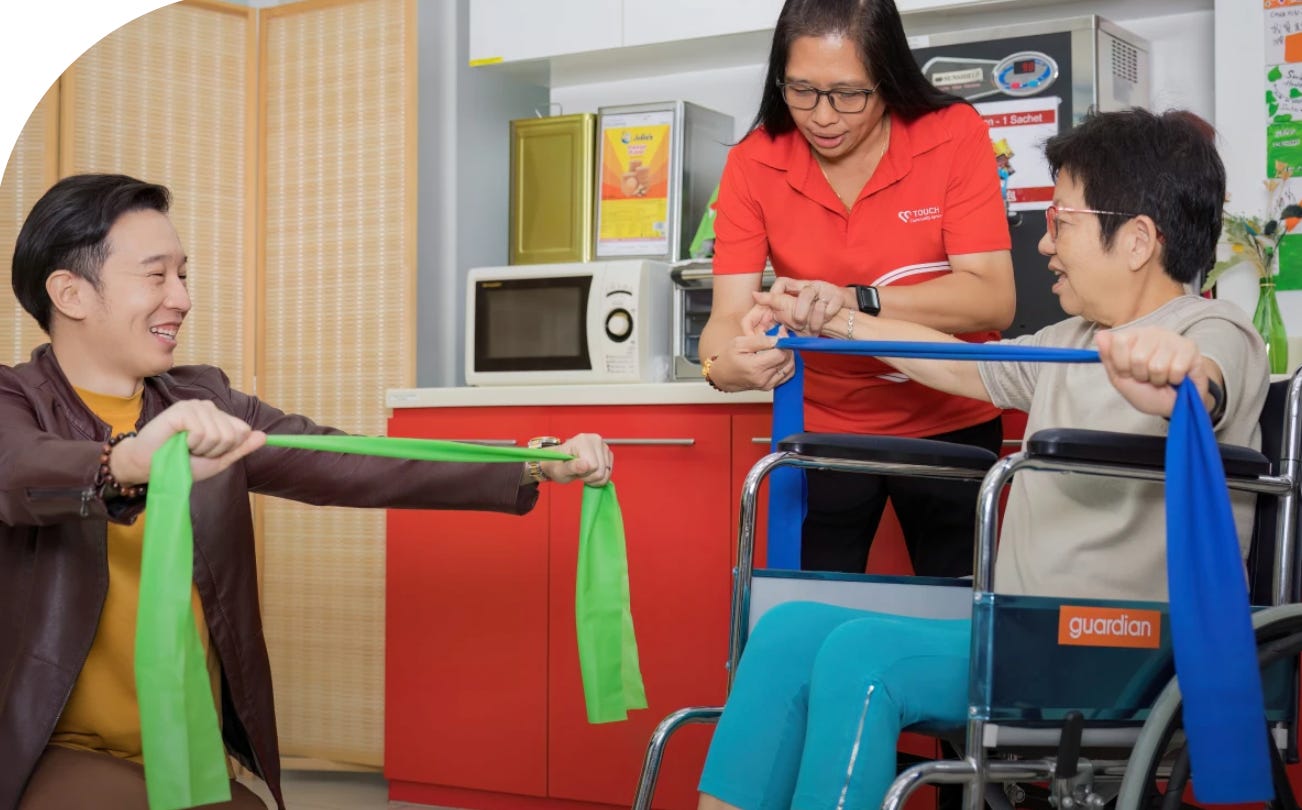
Question 1: Visual Stimulus
“Look at the picture. What is the community care worker doing, and why is her job important?”
Thought (T): The community care worker is patiently helping an elderly woman with an art activity and keeping her company, which is incredibly important for the senior’s well-being.
Reason (R): Many elderly folks might feel lonely or struggle with daily tasks due to their age. The care worker is not just providing physical assistance; she is offering social interaction and emotional support, which keeps the elderly woman’s mind active and her spirits high.
Experience (E): Seeing her warm smile gives me a deep sense of reassurance that our seniors are in good hands. It reminds me of the nurses who took care of my grandmother when she stayed in a community hospital; their patience really helped her recover faster.
Ending (E): Therefore, the work they do is a meaningful and wise choice that greatly improves the quality of life for our elderly.
Question 2: Personal Opinion
“Would you consider taking up a job as a community care worker in the future? Why or why not?”
Thought (T): Yes, I would definitely consider a career in community care because I find joy in helping others.
Reason (R): While I know the job can be very tiring and requires a lot of patience, it is a very noble profession. Knowing that I can make a direct, positive impact on a vulnerable person’s life is highly rewarding.
Experience (E): In school, I volunteer as a peer support leader, and I often byte the bullet to spend my recess helping juniors who are struggling with their work. Seeing them smile when they finally understand a concept gives me a great sense of fulfillment. I believe working with the elderly would forge a similar strong sense of camaraderie and purpose.
Ending (E): By choosing such a path, I can do my part to give back to the society that raised me.
Question 3: Solution-Based
“Besides increasing their salaries, how else can society show appreciation for community care workers?”
Thought (T): Society can show appreciation by giving them public recognition and by treating them with utmost respect in our daily lives.
Reason (R): Sometimes, care workers face unreasonable demands or rude behaviour from patients’ families. Treating them graciously costs nothing but means everything to someone doing a difficult job.
Experience (E): For instance, the government or media could run campaigns highlighting their inspiring stories, similar to the tributes we give to our frontline nurses. Furthermore, if my family has to interact with care workers, my parents always inculcate the habit of saying a sincere “thank you” and offering them a warm smile.
Ending (E): Through simple acts of gratitude and respect, we can be proactive in making them feel valued and motivated in their vital roles.
Fun reading……………..
Theme: Empathy / Community Care / Career Choices
Visual Stimulus: A photo taken in a bright, modern senior care centre in Singapore. A young female community care worker in a uniform is smiling warmly as she helps an elderly woman in a wheelchair complete a simple art and craft activity. They look like they are enjoying a pleasant conversation.
📖 Vocabulary List
Exponentially (Adverb): (With reference to an increase) more and more rapidly.
Intermediate (Adjective): Coming between two things in time, place, order, character, etc. (e.g., intermediate care bridges the gap between hospital and home).
Defray (Verb): Provide money to pay (a cost or expense).
Remuneration (Noun): Money paid for work or a service; salary.
Noble (Adjective): Having or showing fine personal qualities or high moral principles and ideals.
🌟 Idiom of the Day
“A heart of gold”
Meaning: To be exceptionally kind, generous, and caring towards others.
PSLE Oral Usage: “Community care workers truly have a heart of gold, as they dedicate their lives to looking after our vulnerable seniors.”