
PSLE#24 English Oral – Sharing the Path: Enhancing Safety for All
PSLEhacker Episode #24

Date of News Article: 5 February 2026 (Based on the passing of the Land Transport and Related Matters Bill) Source: Adapted from The Straits Times & CNA (Transport & Safety)
Reading Passage:
In recent years, Personal Mobility Aids (PMAs), such as motorised wheelchairs and mobility scooters, have become a common sight in Singapore. These devices were thoughtfully introduced to help the elderly and those with walking difficulties regain their independence. However, a growing trend of able-bodied individuals misusing these devices has led to significant safety concerns on our public paths.
To address this and protect vulnerable pedestrians, Parliament recently passed new, stricter regulations that will take effect on 1 June 2026. A key change is that the speed limit for all PMAs on public paths will be reduced from 10km/h to 6km/h. This new limit matches the pace of a brisk walker, ensuring that PMAs serve their original purpose without endangering others.
Furthermore, to tackle the root of the problem, users of mobility scooters will now be required to obtain a Certificate of Medical Need from a doctor or occupational therapist. To minimise inconvenience to genuine users, seniors aged 70 and above, as well as those already under existing disability schemes, will be exempted from this requirement.
Strict size and weight limits will also be enforced to ban oversized, heavily modified PMAs from footpaths. Enforcement officers will actively patrol estates to ensure compliance. However, laws alone are not enough. Building a gracious society requires everyone to take a proactive stance in showing consideration. When we inculcate the habit of sharing paths safely and giving way to those in genuine need, we make a meaningful and wise choice that protects our community.
Word Count: 288 words
PSLE Oral Practice: Stimulus-Based Conversation (TREE Method)
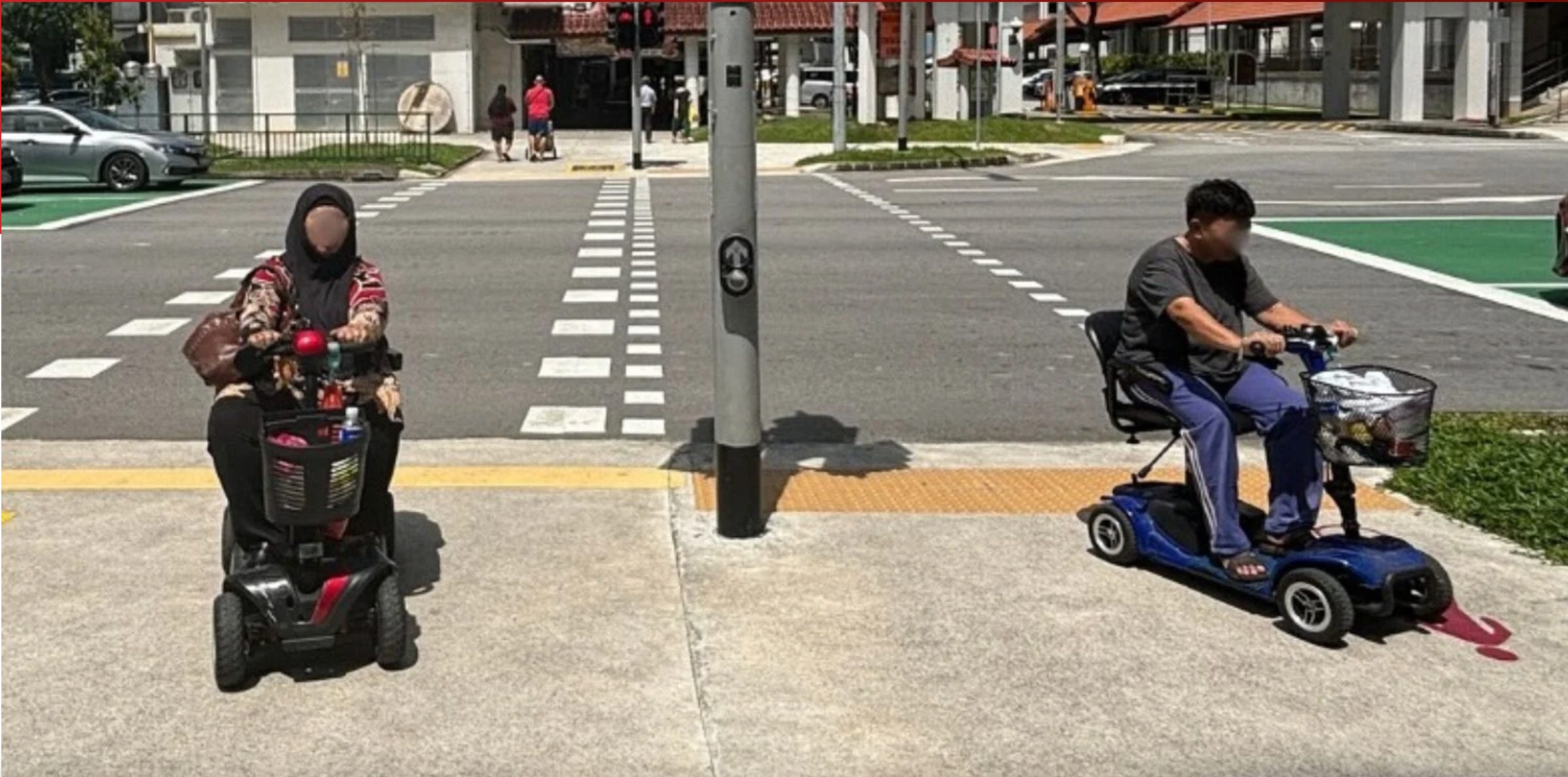
Question: “Do you think it is safe for PMAs and pedestrians to share the same footpaths in Singapore?”
T (Topic Sentence): I believe that it is generally safe for PMAs and pedestrians to share footpaths, provided that every user remains proactive and considers the safety of others.
R (Reasons): * Firstly, PMAs are indispensable for our elderly pioneers as they provide mobility and independence to those who may be too frail to walk long distances.
Secondly, Singapore’s infrastructure, such as the wide paths and tactile paving shown in the picture, is designed to accommodate both groups safely.
E (Explanation & Examples): * However, safety can be compromised if users are oblivious to their surroundings. For example, if a student is distracted by their phone while walking, they might not notice a PMA approaching, which could lead to a detrimental collision.
In my own experience, I always make a meaningful and wise choice to keep to the left and give way when I see a senior on a scooter. This small act of civic-mindedness ensures that everyone can weather the storm of a crowded peak-hour commute without any accidents.
E (Ending): In conclusion, sharing paths is safe only if we do our part to stay alert and maintain a gracious attitude toward more vulnerable road users.
Topic: Road Safety and Inclusivity (PMA Users)
Visual Stimulus: A photo of two elderly individuals on motorized Personal Mobility Aids (PMAs) waiting at a traffic light crossing in Singapore.
📖 Vocabulary Highlight for this Topic
Tactile Paving: The yellow “bumpy” tiles on the floor (seen in your image) that help the visually impaired.
Inclusive: Including everyone, especially those with disabilities.
Pioneers: A respectful way to refer to the elderly generation in Singapore.
Vulnerable: People who are at higher risk (like the elderly on the road).
🌟 Idiom of the Day
“An accident waiting to happen”
Meaning: A dangerous situation in which it is very likely that an accident will occur soon.
PSLE Oral Usage: “Speeding on a crowded footpath with an oversized device is simply an accident waiting to happen.”