
PSLE#16 English Oral - Environmental Sustainability / Community Food Rescue
PSLEhacker Episode #16 - TREE Method

Date of News Article: 5 February 2026 Source: Adapted from The Straits Times (Environment & Society) Word Count:
Reading Passage:
When shopping for groceries, most consumers instinctively reach for the shiniest apples and the straightest carrots. For years, fruits and vegetables with slight blemishes or odd shapes were left on the shelves and eventually thrown away, contributing to a massive food waste problem. In Singapore, food waste accounts for one of the largest waste streams, with hundreds of tonnes generated every day.
However, a shift in mindset is underway. Major supermarkets across the island have introduced “Ugly Food” corners. Here, perfectly edible but visually imperfect produce is sold at heavily discounted prices. This initiative aims to educate the public that a crooked cucumber or a slightly bruised tomato is just as nutritious and tasty as its “perfect” counterpart.
Environmental groups have praised this move, noting that reducing food waste at the consumer level lessens the burden on our incineration plants. It also respects the hard work of farmers and the resources, such as water and land, used to grow the crops.
Schools are also taking up the mantle, organizing trips to local farms to inculcate a deeper appreciation for where our food comes from. By choosing to purchase imperfect produce, families are taking a proactive stance against waste. They are teaching the younger generation to look beyond surface appearances and make a meaningful and wise choice. Embracing “ugly food” is a small but powerful step towards a more sustainable and resource-conscious Singapore.
286 words count
PSLE Oral Practice: Stimulus-Based Conversation (TREE Method)
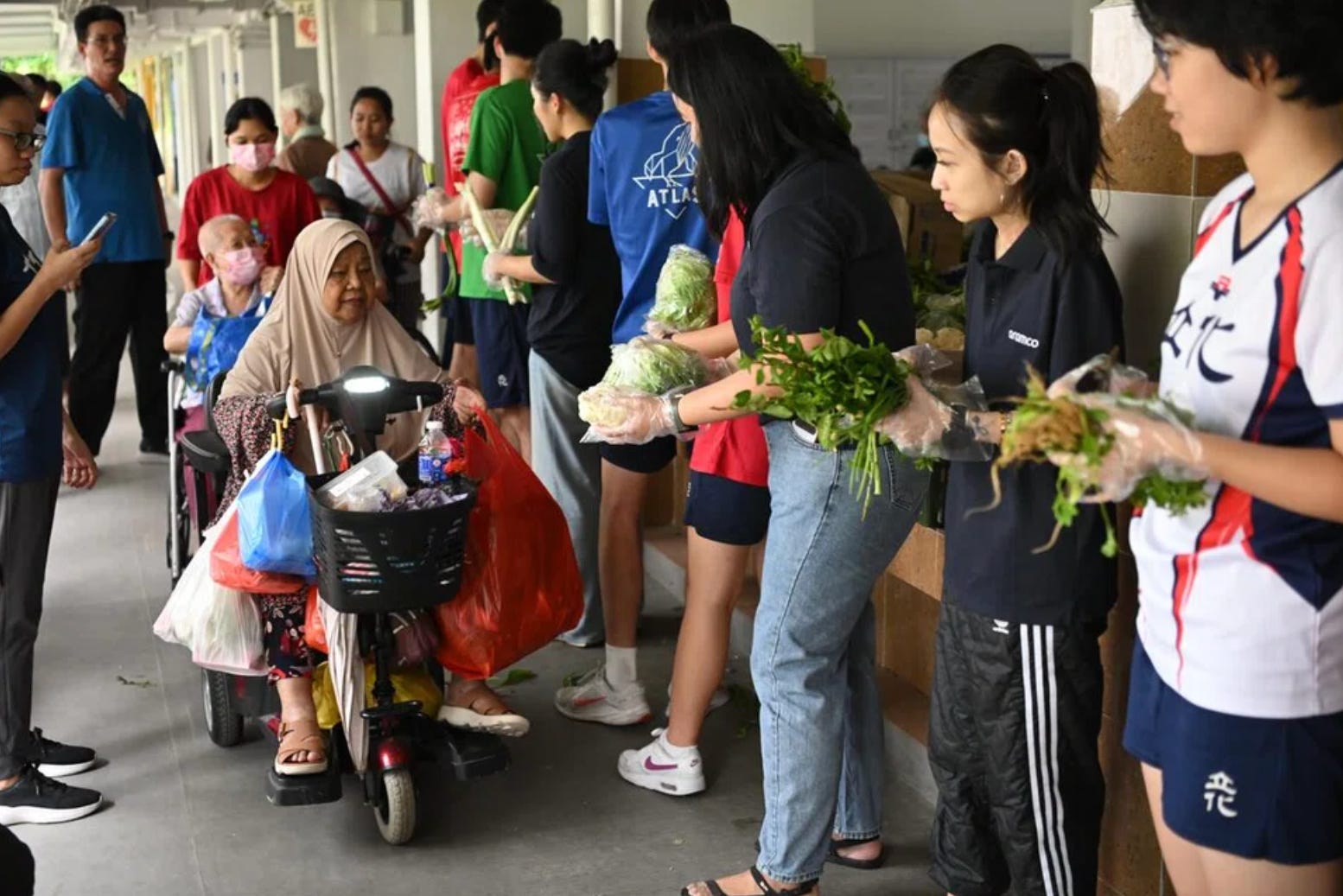
Question 1: Visual Stimulus
“Look at the picture. What are the young volunteers doing, and why is this a meaningful activity?”
Thought (T): The young volunteers are distributing fresh vegetables to elderly residents in the community, likely as part of a food rescue programme.
Reason (R): This activity is highly meaningful because it tackles two problems at once: it prevents perfectly edible, unsold food from being wasted, and it helps residents save money on their groceries.
Experience (E): I have seen similar initiatives near my own neighbourhood where volunteers set up tables to give away unsold bread from local bakeries at night. Seeing the smiles on the elderly residents’ faces when they receive the food always gives me a deep sense of accomplishment on behalf of the community.
Ending (E): Therefore, redistributing food is a wise choice that protects the environment while caring for our neighbours.
Question 2: Personal Opinion
“If your school organized a food rescue drive over the weekend, would you volunteer to help? Why or why not?”
Thought (T): Yes, I would definitely volunteer to help out with the food rescue drive.
Reason (R): It is a hands-on way to make a real difference. Instead of just learning about food waste in textbooks, I would be taking proactive steps to solve the problem while also practicing how to communicate respectfully with the elderly.
Experience (E): Even though giving up my weekend morning means I have to byte the bullet and wake up early, the experience would be worth it. Working alongside my classmates to pack and distribute the vegetables would definitely help to forge a strong sense of camaraderie among us.
Ending (E): By participating, I can do my part to reduce waste and bring a little joy to the older folks in my estate.
Question 3: Solution-Based
“Besides organizing community distribution drives, what can families do at home to reduce the amount of food they throw away?”
Thought (T): Families can practice portion control during meals and learn how to plan their grocery shopping more carefully.
Reason (R): A lot of food waste happens simply because we buy more than we need, or we cook too much and throw the leftovers away.
Experience (E): In my home, we have a “clean plate” rule. My parents inculcate the habit of only taking the amount of rice and meat we can actually finish. Also, my mother checks the refrigerator before going to the supermarket so we do not buy duplicate items that will end up expiring.
Ending (E): Through careful planning and a bit of discipline, every family can easily reduce the food waste generated right in their own kitchens.
Good to read more…………
Theme: Environmental Sustainability / Community Food Rescue : A photo taken at an HDB void deck. Young volunteers wearing plastic gloves are distributing fresh green vegetables to elderly residents. An elderly Malay woman seated on a Personal Mobility Aid (PMA) is receiving the produce, her front basket already filled with assorted vegetables in plastic bags.
📖 Vocabulary List
Discard (Verb): To throw away or reject something that is unwanted.
Grassroots (Adjective): The most basic level of an activity or organization, involving ordinary people in a society.
Dual (Adjective): Consisting of two parts, elements, or aspects (e.g., serving a dual purpose).
Nourish (Verb): Provide with the food or other substances necessary for growth, health, and good condition.
Redistribute (Verb): To distribute something differently or again, typically to achieve greater social equality.
🌟 Idiom of the Day
“Kill two birds with one stone”
Meaning: To achieve two different things with a single action.
PSLE Oral Usage: “Food rescue programmes kill two birds with one stone by saving the environment from waste and providing fresh food to the needy.”