
PSLE#15 English Oral - Packing It Right: The Rise of the BYO Culture
PSLEhacker Episode #15 - TREE Method

Date of News Article: 15 January 2026 (Adapted from recent Straits Times & NEA campaigns) Source: Adapted from The Straits Times (Environment & Community)
Reading Passage:
Walk into any hawker centre or school canteen during lunchtime, and you might notice a colorful change. Instead of carrying away their food in brown paper boxes or plastic bags, a growing number of Singaporeans are handing over their own reusable containers to stallholders. This is the heart of the “Bring Your Own Container” (BYOC) movement, a crucial step in Singapore’s battle against packaging waste.
For years, single-use plastics have clogged our bins and threatened our environment. In response, the National Environment Agency (NEA) launched the “Say YES to Waste Less” campaign, strongly encouraging citizens to ditch disposables. Many schools have taken the lead by completely banning plastic straws and disposable cutlery in their canteens. To further incentivize this habit, several food stalls and local businesses now offer small discounts or extra portions to customers who bring their own lunchboxes or cups.
While the change requires a little extra effort—such as remembering to pack a container and washing it afterward—the environmental benefits are massive. Environmentalists note that this simple daily habit significantly reduces the amount of solid waste sent to the Semakau Landfill, which is projected to run out of space if our habits do not change.
The BYO movement is not just about saving the earth; it is about taking proactive responsibility for our actions. When youths pack their meals in reusable containers, they inculcate a mindset of mindfulness and conservation. It shows that they are making a meaningful and wise choice, proving that even small, individual actions can ripple outward to create a much cleaner, greener home for everyone.
Word Count: 288 words
PSLE Oral Practice: Stimulus-Based Conversation (TREE Method)
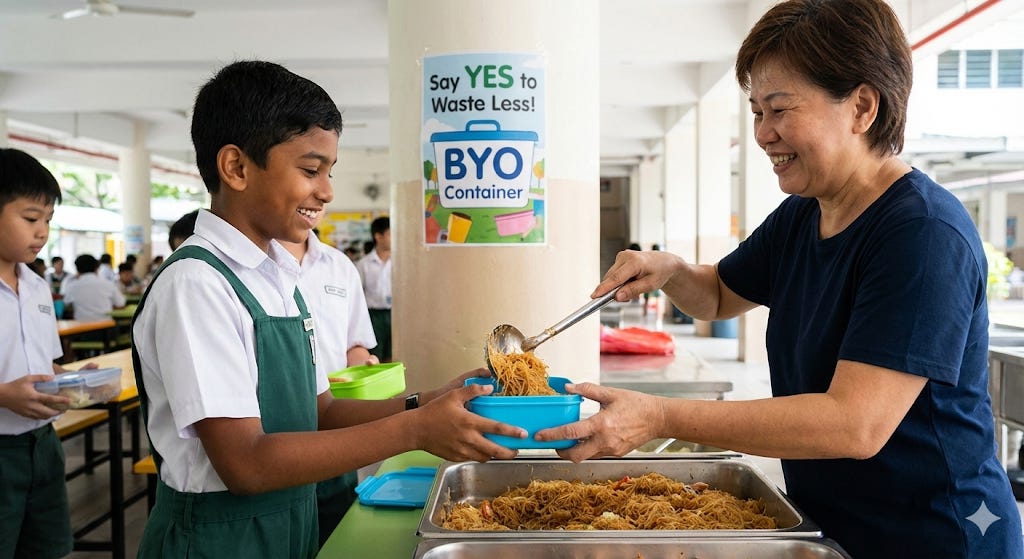
Question 1: Visual Stimulus
“Look at the picture. What is the boy doing, and how does his action help the environment?”
Thought (T): The boy is practicing the “Bring Your Own” habit by using a reusable container to buy his food, which helps reduce plastic waste.
Reason (R): By handing his own blue container to the canteen auntie, he is actively avoiding the use of disposable styrofoam boxes or plastic bags that would end up in the trash. The auntie’s supportive smile shows that she appreciates his eco-friendly effort.
Experience (E): He looks very natural doing it, showing that it has become a good habit. It reminds me of my own school canteen where we are encouraged to bring our own lunchboxes. Whenever I remember to bring mine, I feel a deep sense of accomplishment knowing I saved one more plastic box from being thrown away.
Ending (E): Choosing to reuse rather than throw away is a meaningful and wise choice for protecting our environment.
Question 2: Personal Opinion
“Do you and your family practice bringing your own containers or bags when you buy food or groceries? Share your experience.”
Thought (T): Yes, my family makes a conscious effort to bring our own reusable shopping bags and sometimes our own containers for takeaways.
Reason (R): Ever since the supermarkets started charging for plastic bags, my parents inculcated the habit of keeping folded reusable bags in our car and bags so we are always prepared.
Experience (E): In the beginning, we always forgot and had to byte the bullet to pay for the plastic bags. But now, it is second nature. Last weekend, my mother and I brought our own ‘tingkat’ (tiffin carrier) to the hawker centre to pack dinner. The stall owner even gave us an extra piece of tofu for being eco-friendly! It forged a strong sense of camaraderie between us and the hawker.
Ending (E): It takes a little practice, but making this a family habit is a proactive way to contribute to a greener Singapore.
Question 3: Solution-Based
“Besides offering discounts, how else can schools or hawker centres encourage more people to stop using disposable plastics?”
Thought (T): They can set up convenient washing stations and run educational campaigns to make the BYO process easier and more understandable.
Reason (R): One of the main reasons people dislike bringing their own containers is the hassle of carrying around a dirty box after eating.
Experience (E): If hawker centres and schools installed dedicated washing sinks with soap, people could quickly rinse their containers after their meals. Furthermore, schools could organize “Zero Waste” inter-class competitions where the class that uses the least amount of disposables wins a prize. This makes saving the earth fun-filled and encourages everyone to participate.
Ending (E): By removing the inconvenience and making it a team effort, we can smoothly shift society away from its reliance on plastics.
Reading on your free time……………..
Theme: Environmental Sustainability / Good Habits Visual Stimulus: A photo taken at a school canteen stall. A cheerful Singaporean primary school student (a Malay boy in uniform) is handing a bright blue, clean, reusable Tupperware container to the canteen auntie. The auntie is smiling and using a ladle to scoop hot food into his container. In the background, a poster reads “Say YES to Waste Less!”.
📖 Vocabulary List
Reusable (Adjective): Able to be used again or more than once.
Incentivize (Verb): Provide (someone) with a reason or reward for doing something.
Mindfulness (Noun): The quality or state of being conscious or aware of something.
Disposables (Noun): Articles that are intended to be thrown away after one use.
Proactive (Adjective): Creating or controlling a situation by causing something to happen rather than responding to it after it has happened.
🌟 Idiom of the Day
“Do your part”
Meaning: To take responsibility and contribute to a shared task or goal.
PSLE Oral Usage: “Even though it is just one plastic box, choosing to use a reusable container is how I do my part to save the environment.”