
PSLE#13 English Oral - Gold Bar: A New Way to Save
PSLEhacker Episode #13 - PEEL Method

Date of News Article: 15 February 2026 Source: Adapted from The Straits Times (Money & Youth)
Reading Passage:
In a world increasingly dominated by digital wallets and cashless payments, a surprisingly traditional trend is making a comeback in Singapore: buying physical gold. Recently, retailers and local banks have noted a significant rise in families purchasing small, one-gram to five-gram gold bars. Rather than viewing it solely as an investment for the wealthy, many parents are now using these small, affordable gold bars as a tangible way to teach their children about financial literacy.
Unlike numbers on a screen, a physical gold bar gives youths a concrete understanding of value and savings. During recent festive seasons, some parents have even chosen to gift small gold bars encased in decorative cards instead of the usual red packets or cash. Financial experts praise this trend, noting that holding a physical asset helps young people understand the concept of wealth preservation, especially when the prices of everyday goods fluctuate.
To make it even more accessible, “gold vending machines” and digital-to-physical gold savings accounts have been introduced in various shopping malls across the island. These innovations allow individuals to purchase small amounts of gold conveniently.
However, educators remind students that while saving in gold is a proactive step toward building a nest egg, the true lesson lies in the habit of saving itself. Whether it is putting coins into a piggy bank or safely storing a small gold bar, the goal is to inculcate patience and discipline. By learning to manage their resources early, students are making a meaningful and wise choice that will provide them with a strong foundation for their future financial well-being.
Word Count: 292 words
(B) Stimulus-Based Conversation (SBC):
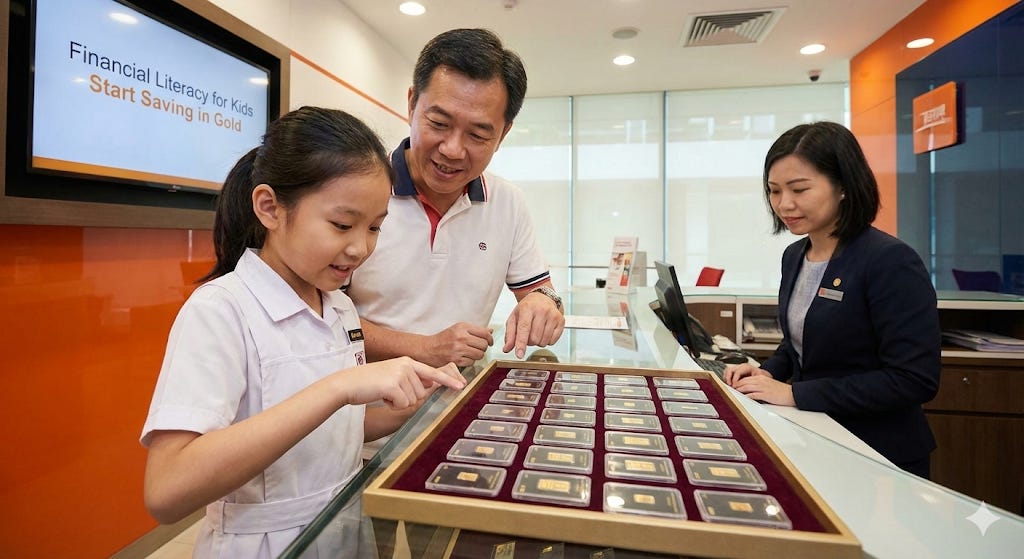
Question 1: Visual Stimulus
“Look at the picture. What is the girl looking at on the counter, and what do you think her father is teaching her?”
Point: The girl is looking at a display of multiple small gold bars, and her father is likely teaching her about the value of physical savings and wealth preservation.
Explanation: Seeing so many shiny gold bars at once is a very eye-catching experience. Instead of just talking about money abstractly, her father is using this impressive collection to explain how real assets hold their value over time. His supportive smile shows he is encouraging her to understand financial responsibility.
Example/Experience: She looks deeply engrossed and amazed by the sheer number of gold bars on the counter. It reminds me of the time my parents showed me how compound interest works by stacking different amounts of coins on the table to represent my savings growing. Seeing a physical representation of wealth gives a deep sense of accomplishment.
Link: Taking the time to learn about different types of savings, like these physical gold bars, is a meaningful and wise choice that builds a strong financial foundation.
Question 2: Personal Opinion
“If it were your birthday, would you prefer to receive a traditional gift like toys, cash, or something like a small gold bar to save? Why?”
Point: While toys are fun for a short time, I would prefer to receive something that holds its value, like cash or a small gold bar.
Explanation: Toys break or get outgrown quickly, but savings can grow over time and be used for something much more important in the future, like my education.
Example/Experience: Last year, instead of asking for a new video game, I decided to byte the bullet and ask my relatives for cash contributions to my savings account. Watching my savings grow has been a surprisingly fun-filled journey. If I received a gold bar, it would be a great physical reminder of my goal to be financially responsible.
Link: Therefore, choosing gifts that help me save is a proactive step toward my future.
Question 3: Solution-Based / Broader Context
“Besides giving them money or gold, how else can parents teach their children good financial habits?”
Point: Parents can involve their children in daily financial decisions, such as creating a family budget or comparing prices at the supermarket.
Explanation: Financial literacy is best learned through practical, everyday actions rather than just lectures.
Example/Experience: Whenever my family goes grocery shopping, my mother gives me a budget and asks me to help compare the prices of different brands. Sometimes, we work together to find the best deals, which helps to forge a strong sense of camaraderie between us. She always tries to inculcate in me the difference between a “need” and a “want.”
Link: By involving children in these daily choices, parents ensure that good money habits become a natural part of their lives.
Good to continue reading ……………….
Theme: Financial Literacy / Good Habits Visual Stimulus: A photo of a Singaporean primary school student (a Chinese girl) standing in a modern bank or retail shop. Display of shiny 1-gram gold bar packaged in a clear protective card, looking at it with a fascinated and happy expression. Her father is standing next to her, smiling and explaining something about it.
📖 Vocabulary List
Financial Literacy (Noun): The ability to understand and effectively use various financial skills, including personal financial management, budgeting, and investing.
Tangible (Adjective): Perceptible by touch; having physical substance (e.g., a physical gold bar versus digital money).
Fluctuate (Verb): Rise and fall irregularly in number or amount.
Preservation (Noun): The action of maintaining something in its original or existing state.
Nest Egg (Noun): A sum of money saved for the future.
🌟 Idiom of the Day
“Worth its weight in gold”
Meaning: Extremely useful, valuable, or helpful.
PSLE Oral Usage: “Learning how to save money when we are young is a habit that is truly worth its weight in gold.”