
PSLE#12 English Oral - Technology in Education > Hands-on Learning
PSLEhacker Episode #12 - PEEL Method

Date of News Article: 1 March 2026 Source: Adapted from The Straits Times (Technology & Youth)
Reading Passage:
The classrooms of 2026 look remarkably different from those of a decade ago. With the rollout of the “AI-Assistant for All” initiative, students in Singapore are now learning alongside intelligent software designed to personalize their education. These AI tools help students identify their weak spots in subjects like Mathematics and Science, providing instant feedback and tailored practice questions.
However, the rise of AI in schools is a “double-edged sword.” While it offers incredible support, educators are concerned about students becoming overly reliant on technology. “The goal is to use AI as a co-pilot, not an auto-pilot,” explains a local school principal. To address this, schools have introduced “Digital Literacy” modules that teach students how to verify information and use AI ethically.
Students are encouraged to be proactive in their learning. Instead of asking AI for the final answer, they are taught to ask for explanations of complex concepts. This shift aims to inculcate critical thinking skills, ensuring that students remain the masters of their own learning journey.
Group projects have also evolved. Students now use AI to brainstorm ideas and create digital prototypes, which has forged a strong sense of camaraderie as they collaborate on innovative solutions. By embracing these tools responsibly, Singapore’s students are making a meaningful and wise choice to prepare for a future where technology and human creativity go hand in hand. Ultimately, this balanced approach ensures that our youth are not just tech-savvy, but tech-smart.
Word Count: 294 words
(B) Stimulus-Based Conversation (SBC):
Question 1: Visual Stimulus
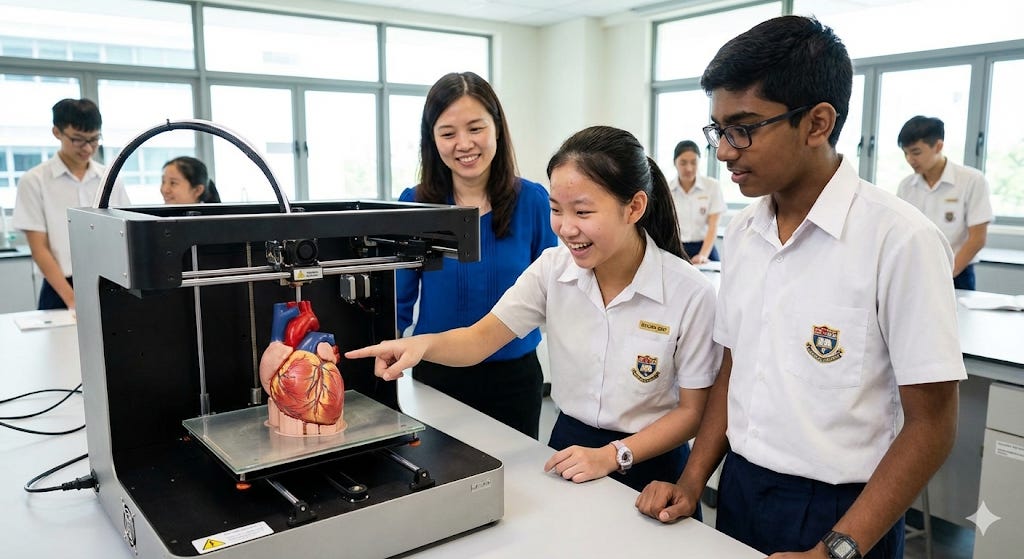
“Look at the picture. What are the students doing, and how do you think this technology enhances their Biology lesson?”
Point: The students are using a 3D printer to create a physical model of a human heart, which makes their learning highly interactive and tangible.
Explanation: Instead of just looking at flat, 2D images in a textbook, this technology allows them to hold, examine, and understand the complex structures of an organ in real life. The teacher’s proud expression shows that this hands-on approach is working well.
Example/Experience: The students look completely amazed and deeply engrossed in the process. It reminds me of a time our science teacher brought in 3D-printed models of animal cells. Being able to touch the different parts helped me ‘byte the bullet’ and finally memorize the difficult terms, giving me a deep sense of accomplishment and pride.
Link: Incorporating such advanced tools is a meaningful and wise choice because it brings abstract science concepts to life.
Question 2: Personal Opinion
“In your opinion, does using advanced technology like 3D printers make learning more effective than using traditional textbooks?”
Point: Yes, I believe it is highly effective, but it should be used to complement textbooks, not replace them entirely.
Explanation: Textbooks are essential for providing the foundational facts and theories. However, technology like 3D printing caters to visual and hands-on learners, making lessons much more fun-filled and memorable rather than feeling like a chore.
Example/Experience: For instance, reading about how a heart pumps blood is informative, but watching a 3D heart being built layer by layer sparks true curiosity. In my own classes, whenever we use technology for group work, it always helps to forge a strong sense of camaraderie among my classmates as we figure out how the machines work together.
Link: Therefore, a blend of both traditional reading and modern technology provides the best, most well-rounded education.
Question 3: Solution-Based / Broader Context
“Aside from providing new equipment, how else can schools prepare students to be ‘Future-Ready’ in a world driven by technology?”
Point: Schools must actively teach digital literacy and coding skills so that students understand how technology works behind the scenes.
Explanation: It is not enough to just know how to press “print” on a 3D printer; students need to learn the software used to design those 3D models. They also need to learn how to be safe and responsible online.
Example/Experience: My school has taken a proactive step by introducing mandatory coding workshops during our post-exam activities. Even though it is challenging, learning to write basic code helps us develop strong problem-solving skills and resilience.
Link: By teaching these underlying skills, schools ensure that we are not just passive consumers of technology, but the future creators and innovators of Singapore.
Helping ………………………
Theme: Technology in Education / Hands-on Learning Visual Stimulus: A photo of Singaporean secondary school students in their white uniforms in a science lab. A Chinese girl is pointing excitedly at a large 3D printer, which is printing a detailed, realistic model of a human heart. Beside her, an Indian boy looks on with a fascinated smile. A teacher stands in the background, observing them proudly.
📖 Vocabulary List
Personalize (Verb): To design or produce something to meet someone’s individual requirements.
Co-pilot (Noun): A person (or tool) who assists the main operator.
Ethically (Adverb): In a way that relates to moral principles.
Prototype (Noun): A first or preliminary version of something from which other forms are developed.
Interactive (Adjective): Allowing a two-way flow of information between a computer and a user.
🌟 Idiom of the Day
“Think outside the box”
Meaning: To think creatively; to find new and unusual ways of doing things.
PSLE Oral Usage: “Using AI tools for our projects encourages us to think outside the box and come up with unique solutions to problems.”