
PSLE #59 English Oral – Courage in the Corridors: Standing Up to Bullying
PSLEhacker Episode #59 - 5W1H Focus

Date of News Article: 10 March 2026 Source: Adapted from School Values & Student Well-being Features
Reading Passage:
Schools are meant to be safe environments where students can learn and grow. Feeling secure in the classroom is an indispensable part of a youth’s educational journey. Unfortunately, conflicts do arise, and sometimes, these conflicts escalate into bullying. Whether it is name-calling in the canteen or teasing on the playground, bullying can cause deep emotional scars.
Often, when bullying occurs, other students witness it but choose to remain oblivious or walk away. They may be afraid of becoming the next target, so they simply stand by. However, true courage means being proactive when someone is being mistreated.
Making the meaningful and wise choice to be an “upstander” rather than a “bystander” can change a victim’s life. An upstander does not need to fight; they simply need to firmly tell the bully to stop or immediately seek help from a teacher. When a victim sees a classmate stepping in to defend them, it provides a deep sense of reassurance that they are not alone.
Schools must encourage youths to look out for one another. When students stand united against unkind behavior, they forge a strong sense of camaraderie that bullies cannot break. By teaching our children empathy and the importance of speaking up, we empower them to help their peers weather the storm of bullying, ensuring that the school remains a gracious and welcoming place for everyone.
Word Count: 275 words
PSLE Oral Practice: Stimulus-Based Conversation (5W1H Focus)
Question 1: Visual Analysis (Using basic 5W1H to describe)
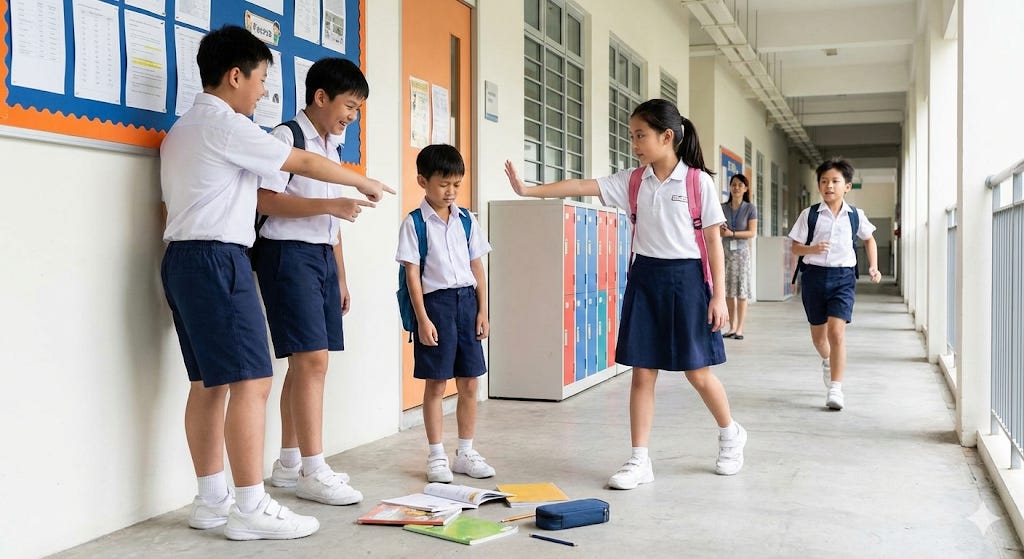
“Look at the picture. Describe the situation and explain who is doing the right thing.”
Who & Where: A group of students is in the school corridor. Two older students are bullying a smaller boy.
What & When: They are laughing at him after he dropped his books.
Why & How: The situation is very unfair to the smaller boy. However, the girl stepping in is doing exactly the right thing. She is being proactive and brave. Making the meaningful and wise choice to tell the bullies to stop gives the victim a deep sense of reassurance. Furthermore, the student running to get the teacher is also an upstander, showing that working together helps the victim weather the storm.
Question 2: Personal Recount (Applying full 5W1H)
“Tell us about a time you saw someone being treated unfairly or bullied. What did you do?” (Note : You can talk about a time someone was left out of a game or teased!)
Who & Where: Last year, during recess at the school canteen, I saw a Primary 3 boy being teased by a group of older boys.
What & When: They were hiding his water bottle and laughing as he tried to get it back.
Why: It was an invaluable lesson in courage for me. I was initially afraid they would target me if I interfered, and I almost pretended to be oblivious.
How: However, I remembered what my teacher taught us about being an upstander. I made the meaningful and wise choice to walk over with two of my friends and firmly ask them to give the bottle back. Because there were three of us, the bullies backed down. Helping him gave me a deep sense of reassurance that I had done the right thing.
Question 3: Opinion & Experience
“Some students are afraid to tell a teacher about a bully because they do not want to be called a ‘tattletale’ or a ‘snitch’. What is your opinion?”
Opinion: I strongly disagree with that fear. There is a massive and indispensable difference between “tattling” and “reporting.”
Reason: Tattling is when you tell a teacher just to get someone in trouble for a minor, harmless thing. Reporting is when you speak up to keep someone safe from harm.
Experience (5W1H style): (When/Where) When a classmate of mine was being cyberbullied in our class group chat last semester, (Who/What) many students just read the mean messages and stayed quiet. (How/Why) I decided to be proactive and take screenshots to show our form teacher. My teacher handled it privately, and the bullying stopped. My classmate thanked me later, which proved that reporting helps us forge a strong sense of camaraderie and protects our friends.
Theme: Bullying / Being an Upstander / Moral Courage Visual Stimulus: A photo taken in a school corridor. Two taller students are laughing and pointing at a smaller boy who has dropped his books and looks visibly upset. However, a brave female classmate is stepping between them, holding her hand up to tell the bullies to stop, while another student in the background is running to call a teacher.
🌟 Mastery Vocabulary List
Upstander: A person who speaks or acts in support of an individual or cause, particularly someone who intervenes on behalf of a person being attacked or bullied.
Bystander: A person who is present at an event or incident but does not take part.
Empathy: The ability to understand and share the feelings of another.
Escalate: To increase rapidly or become more intense or serious.
Intervene: To come between so as to prevent or alter a result or course of events.