
PSLE #58 English Oral – Cents and Sensibility: The Art of Saving
PSLEhacker Episode #58 - 5W1H Focus

Date of News Article: 6 March 2026 Source: Adapted from Youth Financial Literacy & Character Building Features
Reading Passage:
For many primary school students, receiving their daily or weekly pocket money is the highlight of their morning. Having their own cash to spend at the school canteen or bookshop makes them feel grown-up. However, managing this money wisely is an indispensable life skill that takes time to learn.
All too often, youths are oblivious to how quickly small purchases add up. A dollar spent on a sweet drink here and two dollars on a trendy eraser there can empty a wallet by Wednesday. When students spend entirely on their “wants” rather than their “needs,” they lose the opportunity to practice delayed gratification.
Learning to budget requires discipline. We must be proactive in setting aside a small portion of our allowance into a piggy bank or savings account as soon as we receive it. Making this meaningful and wise choice ensures that we have funds set aside for a rainy day or a larger, more valuable item we truly desire, like a new bicycle or a gift for Mother’s Day.
Watching your savings grow over weeks and months provides a deep sense of reassurance. It teaches youths that they do not need instant rewards to be happy. Ultimately, when students learn to save, they build the financial resilience needed to weather the storm of unexpected expenses in the future, setting a strong foundation for responsible adulthood.
Word Count: 270 words
PSLE Oral Practice: Stimulus-Based Conversation (5W1H Focus)
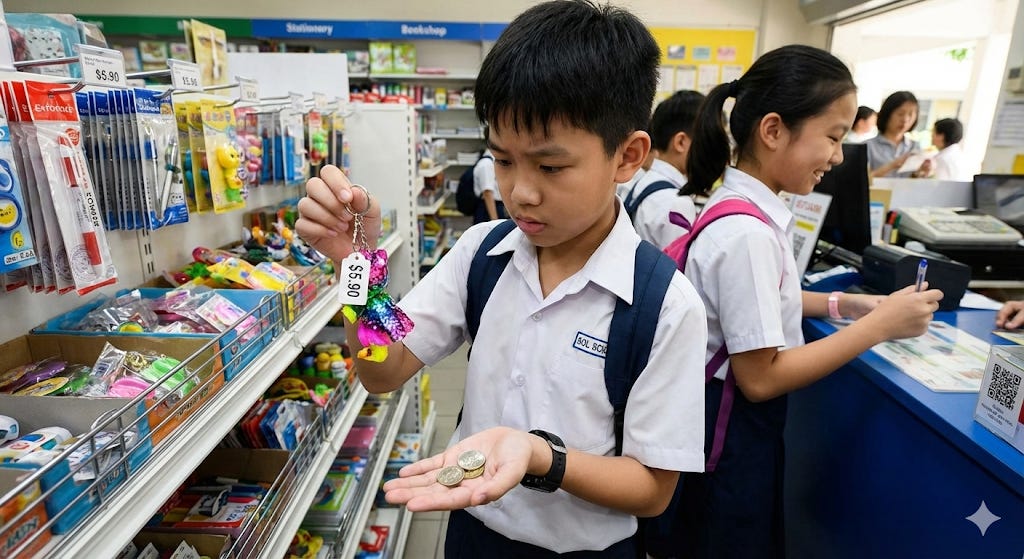
Question 1: Visual Analysis (Using basic 5W1H to describe)
“Look at the picture. Describe the student’s dilemma and explain what you think he should do.”
Who & Where: A student is standing at the school bookshop during recess.
What & When: He is looking at an expensive toy keychain and staring at the few coins left in his wallet, trying to decide if he should buy it.
Why & How: He looks hesitant because he realizes he might not have enough money left for food. I think he should be proactive and put the toy back. Buying a toy is just a “want,” not a “need.” Making the meaningful and wise choice to save his remaining coins instead will give him a deep sense of reassurance that he won’t go hungry later, avoiding the mistake of being oblivious to his actual daily needs.
Question 2: Personal Recount (Applying full 5W1H)
“Tell us about a time you saved up your pocket money to buy something special. Was it difficult?” (Note : Think about saving for a toy, a book, or a present for a family member!)
Who & Where: Last year, I decided to save my own pocket money to buy a beautiful scarf for my mother’s birthday from a mall near our house.
What & When: The scarf cost twenty dollars, so I had to save two dollars a week for two whole months before her birthday in October.
Why: It was an invaluable experience, but it was also quite difficult. I am usually tempted to buy ice cream after school when the weather is hot.
How: Whenever my friends bought snacks, I had to weather the storm of my own cravings and walk away. However, I made the meaningful and wise choice to stick to my goal. When I finally bought the gift and saw my mother’s happy face, it gave me a deep sense of reassurance that my hard work and discipline were completely worth it.
Question 3: Opinion & Experience
“Some parents give their children a daily allowance, while others give a weekly allowance. Which do you think is better for primary school students?”
Opinion: I believe that a weekly allowance is better for upper primary students, even though it is harder to manage at first.
Reason: A weekly allowance is an indispensable tool for teaching real budgeting. If parents just give money every single day, the child remains oblivious to long-term planning because the money magically refills every morning.
Experience (5W1H style): (When/Where) When I started Primary 5, (Who/What) my parents switched me from a daily to a weekly allowance. (How/Why) During the first week, I spent almost all my money by Wednesday and had to eat plain bread on Thursday and Friday! It taught me to be proactive and divide my money properly on Sunday night. Now, I always have extra savings at the end of the week, proving that a weekly allowance helps us forge a strong sense of independence and financial responsibility.
Theme: Pocket Money / Saving Habits / Needs vs. Wants Visual Stimulus: A photo taken at a primary school bookshop. A student in a school uniform is holding a shiny, expensive new toy keychain in one hand and looking at the few coins left in his open wallet in his other hand. He looks hesitant. Beside him, his classmate is happily buying a necessary pen for class.
🌟 Mastery Vocabulary List
Financial Literacy: The ability to understand and effectively use various financial skills, including personal financial management and budgeting.
Delayed Gratification: The ability to resist the temptation for an immediate reward and wait for a later reward.
Budget: An estimate of income and expenditure for a set period of time; a plan for saving and spending.
Dilemma: A situation in which a difficult choice has to be made between two or more alternatives.
Temptation: The desire to do something, especially something wrong or unwise.