
PSLE #57 English Oral – Pitching In: The Value of Household Chores
PSLEhacker Episode #57 - 5W1H Focus

Date of News Article: 4 March 2026 Source: Adapted from Family Life & Youth Development Features
Reading Passage:
In many households today, parents juggle demanding careers while managing the family. Because of this, it is an indispensable duty for youths to step up and help with household chores. Unfortunately, because some families employ domestic helpers, many children grow up entirely oblivious to the massive amount of effort required to keep a home clean and running smoothly.
Some students believe that their only responsibility is to study and pass their examinations. However, learning to manage one’s own living space is a vital life skill. We must be proactive in looking after our environment. Whether it is washing our own plates after dinner, folding our laundry, or simply sweeping the floor, taking ownership of these tasks is a meaningful and wise choice.
When youths pitch in without being nagged, it provides their tired parents with a deep sense of reassurance. It shows that the children are maturing into responsible individuals. Furthermore, doing chores together as a family—like cleaning the house before Chinese New Year—helps members forge a strong sense of camaraderie as a team working towards a common goal.
Ultimately, knowing how to take care of ourselves prepares us for the future. By learning basic domestic skills now, youths build the resilience and independence needed to weather the storm of adulthood, ensuring they can thrive when they eventually step out into the real world.
Word Count: 265 words
PSLE Oral Practice: Stimulus-Based Conversation (5W1H Focus)
Question 1: Visual Analysis (Using basic 5W1H to describe)
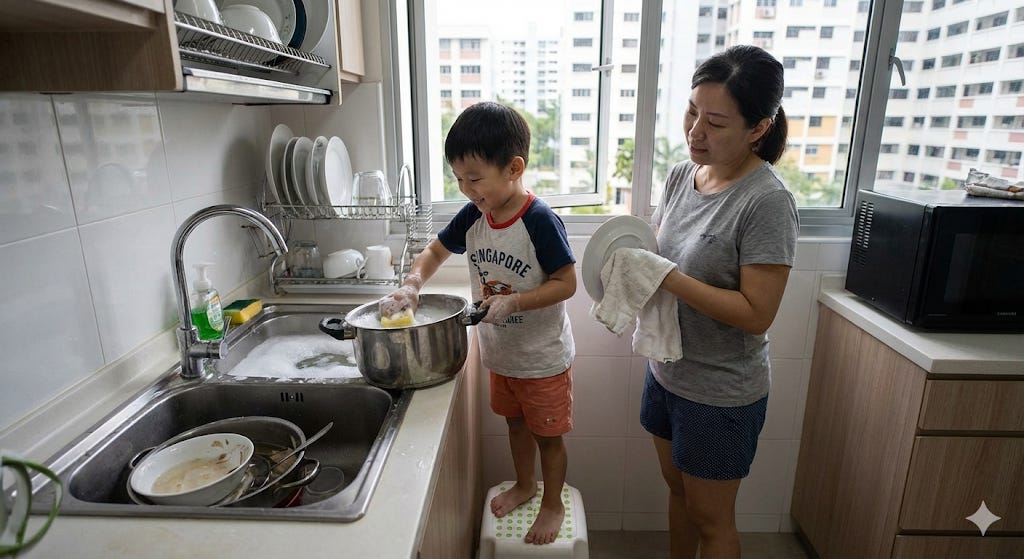
“Look at the picture. Describe what the boy is doing and explain how it makes his mother feel.”
Who & Where: A young boy and his mother are in their home kitchen.
What & When: They are washing and drying the dishes together, likely after a family dinner.
Why & How: The boy is making the proactive choice to help out. He is smiling, which shows he doesn’t mind the work. His mother looks very proud and happy. I believe his actions give her a deep sense of reassurance that he is learning to be independent. Sharing this simple household task helps them forge a strong sense of camaraderie and lightens the mother’s workload.
Question 2: Personal Recount (Applying full 5W1H)
“Tell us about a household chore you are responsible for at home. How did you learn to do it?” (Note : Talk about your daily routine, like making your bed or feeding a pet!)
Who & Where: In my home, it is my daily responsibility to sweep the living room and fold my own clothes.
What & When: I usually do this every evening after I finish my homework and before I take my shower.
Why: It is an invaluable habit because it teaches me not to leave a mess for others. When I was younger, I was oblivious to how quickly dust gathers.
How: My mother taught me how to hold the broom properly and how to match my socks. At first, I found it tiring, but I made the meaningful and wise choice to do it without complaining. Now, keeping my space neat actually helps me concentrate better when I study.
Question 3: Opinion & Experience
“Some children argue that they should not have to do chores because their only job is to study hard and get good grades. Do you agree?”
Opinion: I strongly disagree with that argument. While getting good grades is important, treating the home like a hotel where everything is done for you is the wrong mindset.
Reason: Life is not just about academic results. If a student gets straight As but doesn’t know how to wash their own shoes or cook a simple meal, they are not truly independent.
Experience (5W1H style): (When/Where) During the Circuit Breaker a few years ago when everyone was stuck at home, (Who/What) my parents were very stressed with working from home. (How/Why) I decided to be proactive by taking over the task of washing the dishes every day. It was a small effort, but it helped my family weather the storm of a stressful period. I learned that being part of a family means contributing, not just taking.
Theme: Household Chores / Independence / Taking Responsibility Visual Stimulus: A photo taken in an HDB kitchen. A primary school boy is standing on a small step stool, smiling as he washes the dinner plates with soapy water in the sink. His mother is standing beside him, drying a cup with a towel and looking at him proudly.
🌟 Mastery Vocabulary List
Domestic: Relating to the running of a home or to family relations.
Independence: The fact or state of being self-reliant and not depending on others for livelihood or subsistence.
Responsibility: The state or fact of having a duty to deal with something or of having control over someone.
Contribute: To give (in order to help achieve or provide something).
Pitch in: Vigorously join in to help with a task or activity.