
PSLE #53 English Oral – Stepping Back in Time: The Magic of Museums
PSLEhacker Episode #53 - 5W1H Focus

Date of News Article: 26 February 2026 Source: Adapted from Heritage & Education Features
Reading Passage:
For many students, learning history simply means memorizing dates and facts from a textbook to pass an examination. However, reading about the past on a flat page can sometimes feel dry and uninspiring. This is why school excursions to places like the National Museum of Singapore are an indispensable part of a student’s educational journey.
Museums bring history to life. Instead of just looking at black-and-white photos, youths can interact with multimedia exhibits, listen to oral history recordings, and see authentic artifacts up close. Walking through these immersive galleries prevents students from remaining oblivious to the struggles and triumphs of our pioneers. It helps them understand the immense effort it took to build our nation.
Furthermore, learning outside the classroom provides a much-needed break from the usual school routine. When classmates explore an exhibition together, discussing what they see and completing worksheets as a team, they naturally forge a strong sense of camaraderie. Group excursions teach students how to be proactive in seeking out information and asking questions rather than just waiting for a teacher to give them the answers.
Ultimately, knowing our roots gives us a deep sense of reassurance about our identity. By making the meaningful and wise choice to pay attention and respect the artifacts during these visits, we honor the past. It teaches the younger generation that the resilience of our forefathers can inspire us to weather the storm of our own modern challenges.
Word Count: 265 words
PSLE Oral Practice: Stimulus-Based Conversation (5W1H Focus)
Question 1: Visual Analysis (Using basic 5W1H to describe)
“Look at the picture. Describe what the students are doing and why this is a good way to learn.”
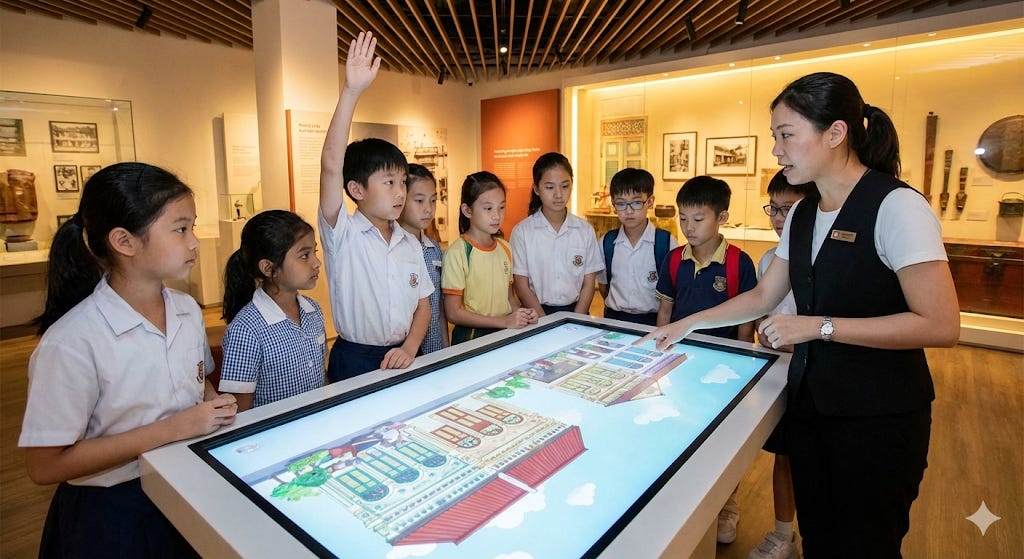
Who & Where: A group of primary school students is on a learning journey at a museum.
What & When: They are listening attentively to a museum guide who is explaining an interactive exhibit during their school excursion.
Why & How: One boy is raising his hand, which shows he is being proactive and curious about the topic. Learning this way is excellent because it is highly engaging. Instead of just reading a textbook, seeing the exhibits with their own eyes helps the students truly understand the subject, while also allowing them to forge a strong sense of camaraderie by learning together outside the classroom.
Question 2: Personal Recount (Applying full 5W1H)
“Tell us about a memorable school excursion you have been on. What did you do and learn?” (Note: Think about your favorite learning journey!)
Who & Where: The most memorable excursion I had was when my Primary 4 class visited the Science Centre.
What & When: We went on a Tuesday morning last year to learn about electricity and magnets.
Why: It was an invaluable experience for me because science is my weakest subject, and I usually find it hard to picture the concepts in my head.
How: During the excursion, we made the meaningful and wise choice to participate in a hands-on workshop where we built our own simple circuits. When my lightbulb finally lit up, it gave me a deep sense of reassurance that I could actually understand the topic. It was much more fun than just doing worksheets!
Question 3: Opinion & Experience
“Some students think that school excursions are just for playing and talking with friends, not for learning. Do you agree?”
Opinion: I strongly disagree. While excursions are definitely fun and a great time to bond with friends, they are an indispensable part of our learning.
Reason: If students treat excursions purely as playtime, they remain oblivious to the rich information around them and waste the effort their teachers put into planning the trip.
Experience (5W1H style): (When/Where) During our trip to the Asian Civilisations Museum last semester, (Who/What) a few of my classmates were just chatting at the back and ignoring the tour guide. (How/Why) Because of that, they couldn’t complete the reflection journal later. I chose to be proactive and listen closely to the guide’s stories about ancient trade routes. It helped me weather the storm of our history quiz the following week because I remembered the stories vividly. Therefore, excursions are highly educational if we have the right attitude.
Theme: School Excursions / Local Heritage / Learning Beyond the Classroom Visual Stimulus: A photo of a group of primary school students in their uniforms on an excursion at a museum. They are gathered around an interactive digital exhibit showcasing old Singaporean shophouses. A museum guide is pointing at the screen, and the students are listening attentively, with one boy raising his hand to ask a question.
🌟 Mastery Vocabulary List
Artifact: An object made by a human being, typically one of cultural or historical interest.
Interactive: Allowing a two-way flow of information between a computer/exhibit and a user.
Heritage: Features belonging to the culture of a particular society, such as traditions, languages, or buildings, that were created in the past and still have historical importance.
Immersive: Noting or pertaining to digital technology or environments that deeply involve one’s senses.
Curious: Eager to know or learn something.