
PSLE #52 English Oral – – Navigating the Digital Maze: Cyber Wellness
PSLEhacker Episode #52 - 5W1H Focus

Date of News Article: 24 February 2026 Source: Adapted from Youth Mental Health & Technology Features
Reading Passage:
In today’s highly connected world, smartphones and tablets have become an indispensable part of our daily lives. From completing online school assignments to chatting with classmates on messaging apps, youths are spending more time glued to their screens than ever before. While technology brings incredible convenience, it also introduces a hidden set of challenges.
A growing concern among educators and parents is the lack of cyber wellness. Many students become so absorbed in social media or mobile games that they grow oblivious to the physical world around them. This constant digital stimulation can lead to poor sleep, increased anxiety, and a significant drop in academic focus. When a phone buzzes with a new notification, it is incredibly difficult for a young mind to resist the urge to check it.
Therefore, setting healthy screen time boundaries is crucial. Rather than letting devices control their schedules, youths must be proactive in managing their digital diets. This means turning off notifications during study hours or keeping phones out of the bedroom at night.
Making the meaningful and wise choice to unplug allows students to recharge their own mental batteries. By putting away our devices during family dinners or outings, we can engage in real-life conversations. This helps us to truly connect with our loved ones and forge a strong sense of camaraderie that simply cannot be replicated through a glowing screen.
Word Count: 270 words
PSLE Oral Practice: Stimulus-Based Conversation (5W1H Focus)
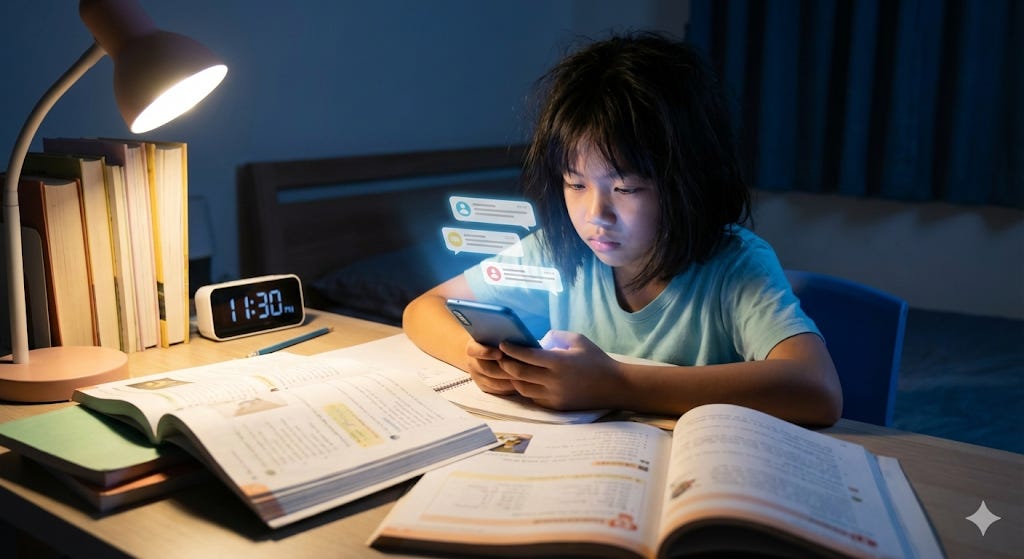
Question 1: Visual Analysis (Using basic 5W1H to describe)
“Look at the picture. Describe the student’s situation and explain why this is a problem.”
Who & Where: A student is sitting at their study desk late at night.
What & When: Instead of focusing on their open textbooks, they are staring at their smartphone as multiple notifications pop up.
Why & How: The student looks very tired and stressed. I say this is a serious problem because the constant notifications are disrupting their concentration. Being oblivious to the late hour and making the choice to check the phone rather than sleep or study will leave them exhausted for school the next day. It shows a lack of proactive screen time management.
Question 2: Personal Recount (Applying full 5W1H)
“Tell us about a time when you were distracted by your digital device. How did you resolve it?” (Note : Think about a time a game or video distracted you from homework!)
Who & Where: Last semester, I was trying to complete my Math revision in my bedroom.
What & When: It was a weekday afternoon, and I kept stopping every five minutes to watch short video clips on my tablet.
Why: The videos were highly addictive, and I ended up wasting two hours. I felt very panicked because I hadn’t finished my work, which taught me an invaluable lesson about digital distraction.
How: To fix the problem, I made the meaningful and wise choice to hand my tablet to my mother until my revision was done. Removing the temptation completely gave me a deep sense of reassurance and allowed me to finally focus and finish my work.
Question 3: Opinion & Experience
“Some parents believe that primary school students should not be allowed to have smartphones at all. Do you agree with this?”
Opinion: I partially agree, but I think a complete ban is unrealistic in today’s digital age.
Reason: Smartphones are an indispensable tool for contacting parents in an emergency or checking school portals. However, I agree that unrestricted access to social media or games is harmful for primary school students.
Experience (5W1H style): (When/Where) When my parents bought me my first phone last year, (Who/What) they sat down with me and set up a screen time limit app. (How/Why) At first, I found it annoying when the phone locked itself at 8:00 PM. But eventually, it helped me weather the storm of digital addiction. I learned to manage my time better, proving that teaching cyber wellness is much more effective than just banning the device entirely.
Theme: Cyber Wellness / Screen Time / Digital Distractions Visual Stimulus: A photo of a student sitting at a study desk late at night. The student’s textbooks are open, but they are looking at their smartphone with a stressed and tired expression. Several notification bubbles are popping up on the screen.
🌟 Mastery Vocabulary List
Stimulation: The raising of levels of physiological or nervous activity in the body.
Unplug: To refrain from using digital or electronic devices for a period of time.
Addictive: Causing a strong and harmful need to regularly do something.
Unrestricted: Not limited or restricted.
Temptation: The desire to do something, especially something wrong or unwise.