
PSLE #50 English Oral – Pedaling on the Waves: The New Sentosa Adventure
PSLEhacker Episode #50 - 5W1H Focus

Date of News Article: 22 February 2026 Source: Adapted from Sentosa Leisure & Outdoor Sports Features
Reading Passage:
For decades, a trip to Sentosa’s beaches meant building sandcastles, playing volleyball, or simply swimming near the shoreline. Recently, however, a thrilling new trend has taken the coast by storm: bicycle canoeing, widely known as water biking. Imagine riding a bicycle, but instead of gliding on a paved road, you are pedaling seamlessly across the sparkling ocean waves.
This innovative sport is rapidly becoming an indispensable weekend activity for adventurous families. Unlike motorized jet skis that produce loud noises and exhaust fumes, water bikes are completely eco-friendly and quiet. This allows riders to enjoy the tranquility of the sea without being oblivious to the natural marine environment around them.
Trying a new water sport can initially be intimidating for youths. However, modern water bikes are designed with high buoyancy, making them incredibly stable and safe. Paddling out together gives families a deep sense of reassurance as they conquer their fear of the open water. Furthermore, pedaling against the ocean currents is a fantastic cardiovascular workout that promotes a healthy lifestyle.
We must be proactive in finding new ways to stay active instead of remaining sedentary indoors. Making the meaningful and wise choice to try outdoor activities like bicycle canoeing allows us to weather the storm of a stressful school week. Ultimately, laughing together while racing across the water helps families forge a strong sense of camaraderie that lasts long after they return to the shore.
Word Count: 280 words
PSLE Oral Practice: Stimulus-Based Conversation (5W1H Focus)
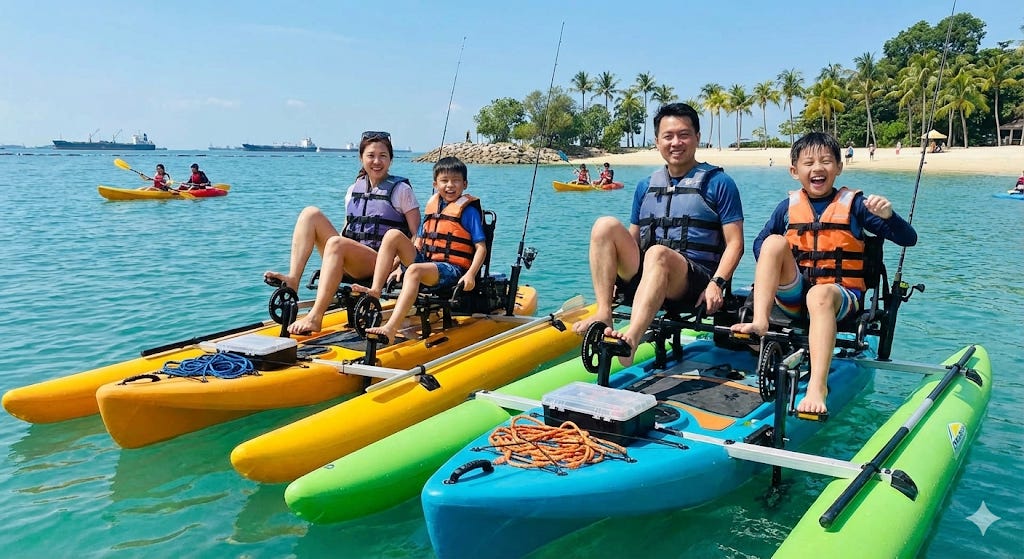
Question 1: Visual Analysis (Using basic 5W1H to describe)
“Look at the picture. Describe what the family is doing and why you think this is a good activity for them.”
Who & Where: A family is spending their day out on the waters of a sunny beach, likely in Sentosa.
What & When: They are riding water bikes together on a bright weekend morning.
Why & How: I think this is an excellent activity because everyone is wearing life jackets, showing they are proactive about water safety. The children are smiling widely, which tells me they are having an exhilarating time. This shared physical activity helps them stay fit and gives the family a deep sense of reassurance that they can safely enjoy the ocean together, helping them forge a strong sense of camaraderie.
Question 2: Personal Recount (Applying full 5W1H)
“Tell us about a time you tried a new outdoor or water activity. How was your experience?” You can talk about swimming, kayaking, or even cycling at the park!
Who & Where: Last December, my parents signed my siblings and me up for a beginner’s kayaking course at MacRitchie Reservoir.
What & When: We spent an entire Saturday morning learning how to paddle and steer the kayak properly.
Why: It was an invaluable experience because I used to be quite afraid of deep water. I was initially very hesitant to step into the boat.
How: However, the instructor was very patient. Once I got the hang of the paddling rhythm, I realized it wasn’t as scary as I thought. Making the meaningful and wise choice to face my fear gave me a massive boost of confidence, and I ended up loving the feeling of gliding on the water.
Question 3: Opinion & Experience
“Some parents feel that water sports are too dangerous for primary school children and prefer them to play indoor sports instead. What is your opinion?”
Opinion: I respectfully disagree with that viewpoint. While water does pose risks, avoiding it entirely is not the solution. I believe learning how to handle water safely is an indispensable life skill.
Reason: If children are entirely shielded from the sea, they might grow up being overly fearful or oblivious to water safety rules. With proper supervision, certified instructors, and mandatory life jackets, water sports are actually very safe.
Experience (5W1H style): (When/Where) During my school’s swimming carnival last year, (Who/What) I saw many students who were confident in the pool because they had been exposed to water activities since they were young. (How/Why) Knowing how to float and stay calm in the water means that if an emergency ever happens, they have the resilience to weather the storm. Therefore, I believe outdoor water sports are highly beneficial when done safely.
Theme: Outdoor Water Sports / Healthy Lifestyle / Overcoming Fear Visual Stimulus: A bright, sunny photo taken at Sentosa’s Siloso Beach. A family is riding brightly colored water bikes (bicycles mounted on canoe-like floats) across the blue water. The children are wearing life jackets, smiling widely, and pedaling excitedly, while the parents are riding alongside them.
🌟 Mastery Vocabulary List
Buoyancy: The ability or tendency to float in water or air or some other fluid.
Intimidating: Having a frightening, overawing, or threatening effect.
Eco-friendly: Not harmful to the environment.
Exhilarating: Making one feel very happy, animated, or elated; thrilling.
Mandatory: Required by law or rules; compulsory.