
PSLE #44 English Oral – Bridging Generations: More Than Just a Visit
PSLEhacker Episode #44 - OREO Method

Date of News Article: 20 February 2026 Source: Adapted from National Council of Social Service (NCSS) & School VIA Feature
Reading Passage:
Singapore is ageing rapidly. By 2030, one in four Singaporeans will be aged 65 and above. While the government builds infrastructure like ramps and lifts to make the city more accessible, physical structures alone cannot build a cohesive society. The emotional connection between the young and the old is fast becoming an indispensable pillar of our community.
In recent years, many schools have moved beyond one-off visits to nursing homes during festive seasons. Instead, they are establishing sustained “intergenerational programs.” These initiatives see students visiting Senior Activity Centres weekly, not just to perform, but to interact.
The exchange is two-way. Tech-savvy youths teach seniors how to use smartphones to video call their families or avoid digital scams, giving the elders a deep sense of reassurance in the digital age. In return, the youths receive invaluable wisdom, learning traditional crafts, dialects, or simply listening to stories about Singapore’s history that cannot be found in textbooks.
Ideally, these interactions help students look beyond a senior’s frail appearance and see the rich life experiences they hold. By being proactive in bridging this gap, the younger generation learns patience and empathy. Making the meaningful and wise choice to spend time with our elders ensures that as our nation grows older, it also grows kinder.
Word Count: 280 words
PSLE Oral Practice: Stimulus-Based Conversation (Advanced O.R.E.O.)
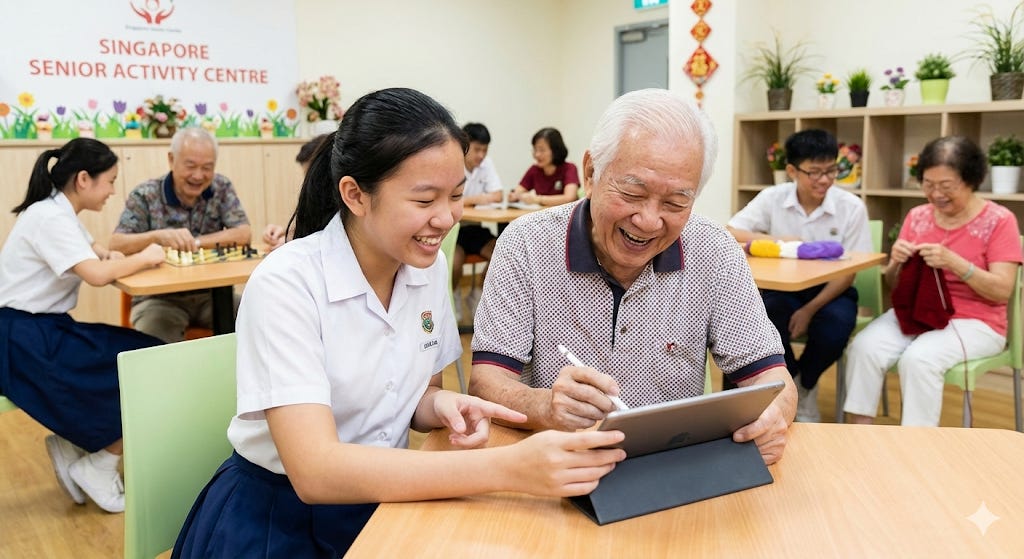
Question 1: Visual Description & Analysis
“Look at the picture. Describe the interaction between the student and the elderly man, and explain why such activities are beneficial for both generations.”
O (Opinion): I see a very warm and positive interaction where a student is patiently teaching an elderly man how to use a tablet, likely sharing digital skills.
R (Reason): This interaction is mutually beneficial. For the senior, learning digital skills prevents them from feeling oblivious or left behind in a tech-heavy world. For the student, taking on the role of a teacher builds confidence and patience. The laughter suggests they have forged a strong sense of camaraderie despite the age gap.
E (Experience): My class participated in a similar Values in Action (VIA) project last year. I was paired with an uncle who used to be a carpenter. While I taught him how to use WhatsApp, he told me amazing stories about building furniture in the 1970s. It made me realize that seniors are vast libraries of invaluable knowledge.
O (Opinion Restated): Therefore, these programs are essential as they replace isolation with connection for both the young and the old.
Question 2: Personal Reflection
“Besides school-organized visits, what can you do in your personal life to show care and respect for the elderly in your family or neighborhood?”
O (Opinion): I believe the best way to show care is to make a proactive effort to spend quality time with them and truly listen to them.
R (Reason): Often, we get so caught up in our schoolwork and phones that we take the elders in our lives for granted. We forget that they might feel lonely. Simple acts of presence are more meaningful than grand gestures.
E (Experience): Every Sunday evening, I make it a point to put my phone away for an hour to have dinner with my grandparents. I ask them about their week or their childhood. Even though they sometimes repeat the same stories, listening attentively gives them a deep sense of reassurance that they are valued and loved.
O (Opinion Restated): Ultimately, making the meaningful and wise choice to prioritize family time is the foundation of respect.
Question 3: Solution-Based (Encouraging Volunteering)
“Many students feel awkward interacting with seniors they don’t know. How can we encourage more youths to volunteer at eldercare centers willingly?”
O (Opinion): To overcome this awkwardness, I think programs should focus on shared interests rather than just “helping.”
R (Reason): If students feel they are just there to “do a duty,” it can feel forced. However, if they are bonding over a shared hobby, the connection becomes natural.
E (Experience): For example, if a student loves art, they could volunteer to paint together with seniors. If they love music, they could have a “jam session” featuring both modern and old songs. When the focus shifts to the activity, the age barrier disappears, and it becomes easier to weather the storm of initial awkwardness.
O (Opinion Restated): By designing engaging, activity-based programs, we can encourage students to see volunteering not as a chore, but as a joyful exchange.
Theme: Intergenerational Bonding / Volunteering (VIA) / Respect & Empathy Visual Stimulus: A heartwarming photo taken at a Senior Activity Centre. A teenage student in school uniform is sitting next to an elderly man with white hair. The student is smiling and pointing at a tablet screen, explaining something. The elderly man is laughing, holding the stylus, and looking engaged. In the background, other student-senior pairs are chatting or doing crafts.
🌟 Mastery Vocabulary List
Cohesive: Well-integrated; unified (describing a society that sticks together).
Invaluable: Extremely useful or indispensable (describing wisdom or experience).
Isolation: The condition of being alone or separated from others (what many seniors face).
Sustained: Continuing for an extended period or without interruption (not just a one-off visit).
Tech-savvy: Well informed about or proficient in the use of modern technology.