
PSLE #43 English Oral – Commuting with Courtesy: The Shared Journey
PSLEhacker Episode #43 - OREO Method

Date of News Article: 20 February 2026 Source: Adapted from Public Transport Council (PTC) Graciousness Campaigns
Reading Passage:
Singapore’s public transport system is undeniably one of the most efficient in the world, moving millions of commuters daily. However, the true mark of a world-class transport system is not just the speed of the trains or the frequency of the buses, but the behavior of the people who use them.
During peak hours, an MRT cabin or a double-decker bus can become incredibly cramped and stressful. In such close quarters, it is easy for commuters to become entirely absorbed in their smartphones and oblivious to the needs of those around them. We have all witnessed instances of people rushing to secure a seat, ignoring the priority queues, or blocking the doors when others are trying to alight.
To combat this, the Public Transport Council constantly runs campaigns to inculcate a culture of care. Commuting should not be a selfish race. Whether it is moving to the rear of the bus to create space, keeping our voices down, or offering a seat to someone who is frail, these small acts are indispensable for a harmonious journey.
We must all strive to be proactive commuters. By looking up from our screens and practicing civic-mindedness, we make a meaningful and wise choice that transforms a stressful, crowded commute into a pleasant shared experience. Ultimately, the grace we show to strangers on our daily journeys reflects the true character of our nation.
Word Count: 285 words
PSLE Oral Practice: Stimulus-Based Conversation (Advanced O.R.E.O.)
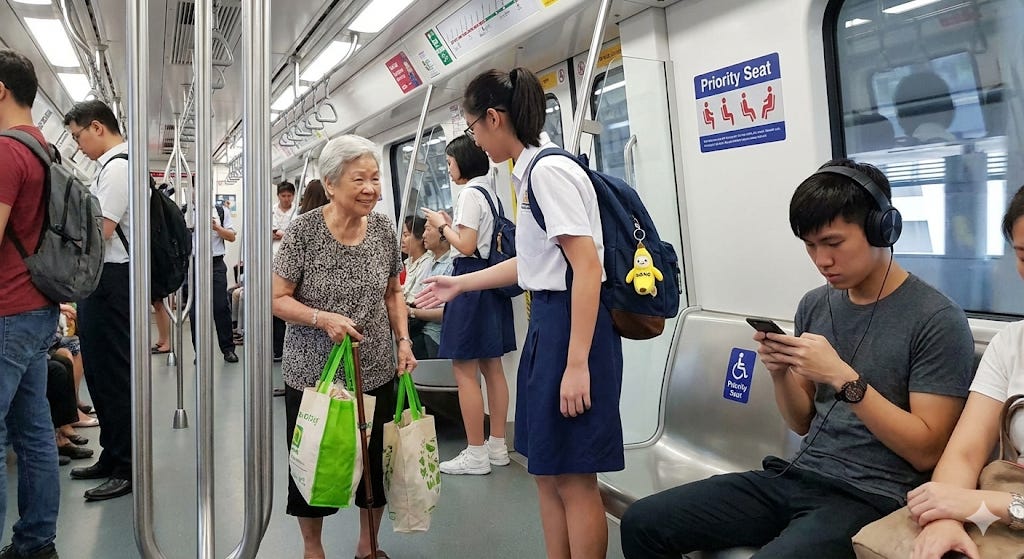
Question 1: Visual Description & Analysis
“Look at the picture. Contrast the behavior of the student and the young adult, and explain what we can learn from this scene.”
O (Opinion): In my opinion, the picture perfectly illustrates the contrast between a proactive, caring commuter and someone who is entirely absorbed in their own world.
R (Reason): The student is making a meaningful and wise choice by giving up his seat to the elderly woman, showing great respect and civic-mindedness. On the other hand, the young adult in the reserved seat is oblivious to his surroundings because of his earphones and screen.
E (Experience): Whenever I take the MRT home after school, I always make it a point not to sit in the reserved seats, even if I am tired. If I do sit in a regular seat, I constantly look up at every station. It gives me a deep sense of reassurance to know that I am doing my part to help those who are more frail or vulnerable.
O (Opinion Restated): Therefore, the student’s behavior is an indispensable example of how we should all act on public transport.
Question 2: Personal Reflection (Dealing with Ungraciousness)
“Have you ever encountered someone being ungracious on public transport? How did you feel and react?”
O (Opinion): Yes, I have witnessed ungracious behavior, and it always makes me feel quite disappointed, though I try to focus on being part of the solution rather than the problem.
R (Reason): When people play loud videos without earphones or refuse to move into the center of the bus, it makes the commute uncomfortable for everyone. It shows a lack of empathy and makes it harder for everyone to weather the storm of a tiring, crowded journey.
E (Experience): Once, I was on a packed bus and a passenger was blocking the exit while playing a loud game on his phone. Instead of getting angry, I politely tapped his shoulder and said, “Excuse me, could you please let us pass?” He realized he was blocking the way and moved. This taught me that sometimes people aren’t malicious; they are just oblivious.
O (Opinion Restated): Ultimately, a polite and proactive approach is the best way to handle such situations.
Question 3: Solution-Based (Encouraging Good Habits)
“What more can schools do to ensure that students naturally offer their seats to those in need without having to be reminded?”
O (Opinion): I believe schools need to inculcate empathy through experiential learning rather than just textbook lectures.
R (Reason): It is easy to know the “rules” of the MRT, but truly understanding why the rules exist requires empathy. If students don’t understand how tiring it is for an elderly person to stand on a moving train, they might not feel the urgency to give up their seat.
E (Experience): If schools organized empathy workshops—perhaps having students wear heavy weights to simulate being elderly or pregnant while trying to balance—it would be a very powerful lesson. Experiencing that difficulty firsthand would forge a strong sense of camaraderie and respect across generations.
O (Opinion Restated): By making the meaningful and wise choice to focus on empathy, schools can ensure that gracious commuting becomes second nature to all youths.
Theme: Public Transport / Graciousness / Civic-Mindedness Visual Stimulus: A drawing of the inside of a crowded MRT train. A student in uniform is standing up and offering his seat to an elderly woman carrying heavy grocery bags. Next to them, a young adult is sitting in a reserved seat, wearing headphones and staring blankly at his phone, completely unaware of the elderly woman.
🌟 Mastery Vocabulary List
Commuter: A person who travels some distance to work or school on a regular basis.
Oblivious: Not aware of or not concerned about what is happening around one.
Harmonious: Free from disagreement or dissent; friendly and peaceful.
Experiential: Involving or based on experience and observation.
Simulate: To imitate the appearance or character of something.