
PSLE #42 English Oral– Beyond the Scoreboard: The True Spirit of School Sports
PSLEhacker Episode #42 - OREO Method

Date of News Article: 20 February 2026 Source: Adapted from School Sports & NSG Highlights
Reading Passage:
Every year, the National School Games (NSG) bring a wave of excitement, anxiety, and school pride to stadiums and sports halls across Singapore. For student-athletes, this is the culmination of months of grueling, rigorous training. Whether it is sprinting on the track, scoring a goal on the netball court, or executing a flawless badminton smash, the physical demands of a Sports CCA are immense.
However, coaches and educators constantly remind students that the true value of sports goes far beyond the final score on the board. In the heat of competition, it is easy for players to become so focused on winning that they become oblivious to the feelings of others. This is why the NSG strongly emphasizes the Olympic values of excellence, friendship, and respect.
Learning to lose gracefully is perhaps the most indispensable lesson a student can learn. When a team faces a devastating defeat, it is a true test of their character. Making the meaningful and wise choice to walk across the court, shake the hands of the opponents, and congratulate them requires immense maturity and civic-mindedness.
Instead of letting a loss break their spirit, athletes learn to weather the storm of disappointment together. By analyzing their mistakes and supporting one another, they forge a strong sense of camaraderie. Ultimately, the resilience built on the playing field prepares these youths for the inevitable challenges they will face in the real world.
Word Count: 285 words
PSLE Oral Practice: Stimulus-Based Conversation (Advanced O.R.E.O.)
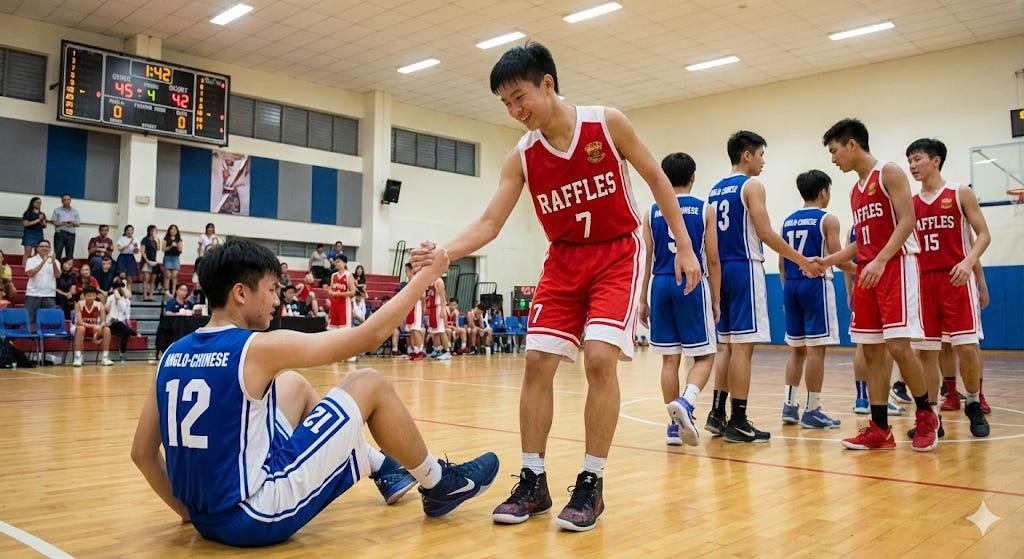
Question 1: Visual Description & Analysis
“Look at the picture. Describe the interaction between the two boys and explain why this behavior is important in sports.”
O (Opinion): In my opinion, the interaction between the two boys perfectly captures the essence of true sportsmanship and respect.
R (Reason): Even though the boy in blue has lost and feels disappointed, the winning captain is being proactive by offering a helping hand rather than boasting or celebrating selfishly. This behavior is crucial because it shows that while they are rivals during the game, they are still peers who respect each other’s hard work.
E (Experience): In my school, our PE teachers always inculcate the rule of “Friendship First, Competition Second.” Whenever we play captain’s ball or badminton during recess, we make it a point to say “good game” at the end, regardless of who wins. It gives me a deep sense of reassurance that I can play hard without making enemies.
O (Opinion Restated): Therefore, showing grace in both victory and defeat is an indispensable quality for any athlete.
Question 2: Personal Reflection (Resilience)
“Share a time when you participated in a competition or a difficult task and did not get the result you wanted. How did you handle it?” * O (Opinion): I vividly remember a time when I did not achieve my desired result, and while it was painful, I realized it was a vital stepping stone for my personal growth.
R (Reason): Losing can feel detrimental to our confidence at first. However, if we make the meaningful and wise choice to view failure as feedback rather than a final destination, we build the mental resilience needed to improve.
E (Experience): Last year, my team trained very hard for the inter-class relay, but we dropped the baton during the race and came in last. Initially, we were very upset. However, instead of blaming the person who dropped it, we chose to weather the storm together. We bought cold drinks for each other and promised to train our hand-offs better for the next year. This helped us forge a strong sense of camaraderie.
O (Opinion Restated): Ultimately, learning to bounce back from a setback is a far more meaningful victory than just winning a medal.
Question 3: Solution-Based (Managing Pressure)
“Sometimes, students feel too much pressure from their parents or schools to win gold medals. What can be done to ensure sports remain healthy and fun?”
O (Opinion): I believe that parents and coaches must actively shift the focus from “winning at all costs” to celebrating “personal bests” and effort.
R (Reason): When the pressure to win becomes overwhelming, students may resort to cheating or become highly stressed, which completely defeats the purpose of a CCA. If adults are oblivious to a child’s mental exhaustion, it can ruin their love for the sport.
E (Experience): My parents have a great approach. Before any spelling test or sports event, they always tell me, “Just do your best; the result doesn’t define you.” This removes the fear of failure and allows me to perform with a clear mind. Schools can also give out “Sportsmanship Awards” instead of just giving trophies to the champions.
O (Opinion Restated): By being proactive in praising character over medals, we ensure that school sports remain a healthy and joyful experience.
Theme: Sportsmanship / Handling Defeat / Resilience Visual Stimulus: A photo inside a school sports hall. A basketball match has just ended. The players in the blue jerseys look disappointed, with one boy looking down at the floor. However, the captain of the winning team (in red) is reaching out his hand to help the boy in blue up, and both are sharing a respectful smile.
🌟 Mastery Vocabulary List
Rigorous: Extremely thorough and careful (used to describe tough physical training).
Culmination: The highest or climactic point of something, especially as attained after a long time.
Gracefully: In a respectful, dignified, and polite manner (e.g., losing gracefully).
Camaraderie: Mutual trust and friendship among people who spend a lot of time together.
Overwhelming: Very great in amount; a feeling that is too strong to handle.