
PSLE#33 English Oral –The Voice of Deceit: Unmasking Impersonation Scams
PSLEhacker Episode #33 - OREO Method

Date of News Article: 20 February 2026 Source: Adapted from Singapore Police Force (Police Advisory)
Reading Passage:
As Singapore enhances its digital defenses, scammers are turning to a more personal and terrifying tactic: impersonation. In a recent two-week operation ending on 12 February 2026, the police investigated 231 people linked to scams that cost victims millions. Among the most damaging are Government Official Impersonation Scams (GOIS), where fraudsters pretend to be officers from the police, Ministry of Law, or banks.
These scammers often use “spoofed” numbers that look like official hotlines. They might claim your bank account is under investigation for money laundering and even show fake staff passes via video call to “prove” their identity. Out of fear, victims are coerced into handing over cash, gold, or banking credentials to so-called “investigation officers”.
To deter these criminals, new laws came into effect on 30 December 2025, introducing mandatory caning of at least six strokes for scam syndicate members. However, the public must remain the first line of defense. Official government bodies will never ask for money transfers or banking details over the phone.
Protecting our families from these predators is a meaningful and wise choice. By inculcating a habit of verifying any “urgent” call with official sources like the ScamShield helpline (1799), we take a proactive step in safeguarding our hard-earned savings. In the digital world, staying calm is our most powerful tool for survival.
Word Count: 298 words
PSLE Oral Practice: Stimulus-Based Conversation (OREO Method)
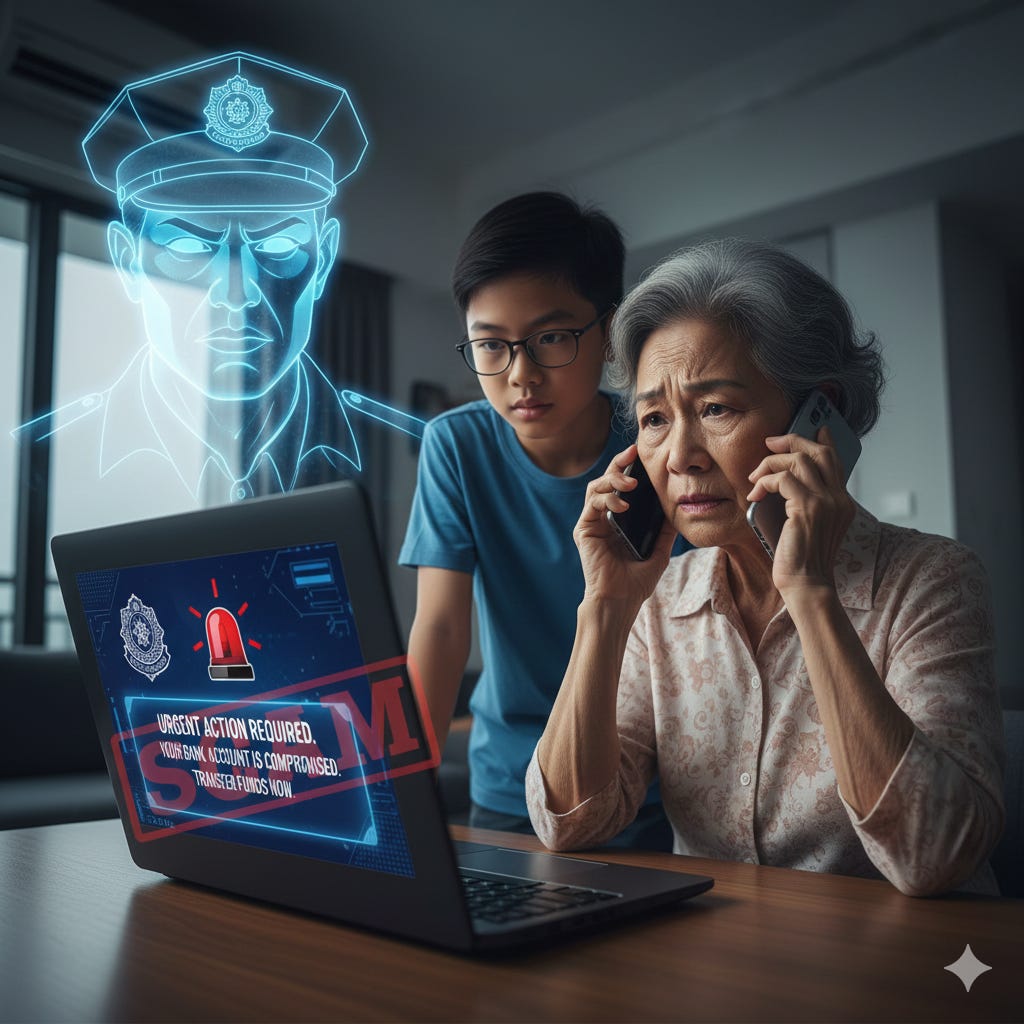
Question 1: Visual Stimulus
“Look at the picture. Why does the boy look suspicious, and what should he say to his grandmother?”
O (Opinion): I believe the boy is suspicious because he recognizes the “urgent” pop-up on the laptop as a classic red flag for an impersonation scam.
R (Reason): Scammers often use official logos and create a sense of panic to trick victims into acting without thinking. The boy likely knows that the real police would never send such an alert asking for immediate action via a pop-up or a phone call.
E (Experience): In my own home, I have inculcated the habit of checking my grandparents’ messages daily. Once, my grandmother received a call claiming she had an “arrest warrant”. I had to byte the bullet and firmly tell her to hang up. We then called the ScamShield helpline at 1799 together to verify, which gave us a deep sense of reassurance.
O (Opinion Restated): Thus, the boy should tell his grandmother to stop the call immediately because being proactive and skeptical is the only wise choice in this situation.
Question 2: Personal Opinion
“Why do you think scammers often target the elderly, and how can we better protect them?”
O (Opinion): I think scammers target the elderly because they may be less familiar with the latest technology and are often more trusting of authority figures.
R (Reason): Seniors grew up in a time when a call from “the bank” was always genuine. They may not realize how easily logos and voices can be faked today.
E (Experience): My family regularly holds “Scam Talk” sessions during dinner where we share news about the latest impersonation tactics. We even helped my grandmother set up “Money Lock” on her bank account, which prevents anyone from transferring out her life savings digitally.
O (Opinion Restated): By sharing this knowledge, we forge a strong sense of camaraderie and ensure our elders are never alone in facing these threats.
Question 3: Solution-Based
“Should the punishment for scammers be more severe? Why or why not?”
O (Opinion): Yes, I strongly support the new mandatory caning laws for scam syndicate members because these crimes destroy lives.
R (Reason): Scammers do not just steal money; they steal the peace of mind and the retirement security of innocent people. A harsh punishment acts as a strong deterrent.
E (Experience): In school, we are taught that every action has a consequence. When I read that scammers now face at least six strokes of the cane, it makes me feel that Singapore is taking a proactive stance to protect us.
O (Opinion Restated): Ultimately, while education is important, a strict legal framework is a meaningful and wise choice to keep our nation safe from transnational syndicates.
To continue………….
Theme: Personal Safety / Critical Thinking / Civic Duty : A photo of an elderly grandmother looking worried as she holds her smartphone to her ear. On the screen of a laptop nearby, a pop-up shows a official-looking police logo with the words “URGENT ACTION REQUIRED.” A young boy is standing beside her, looking at the laptop screen with a suspicious expression.
📖 Vocabulary List
Coerced: Persuaded (an unwilling person) to do something by using force or threats.
Spoofed: Imitating the appearance of a trusted source to deceive a victim.
Transnational: Extending or operating across national boundaries (referring to syndicates outside Singapore).
Mandatory: Required by law or rules; compulsory.
Predators: People who ruthlessly exploit others for their own gain.
🌟 Idiom of the Day
“Wolf in sheep’s clothing”
Meaning: A person or thing that appears friendly or harmless but is actually dangerous.
PSLE Oral Usage: “We must be careful because a scammer posing as a polite police officer is just a wolf in sheep’s clothing trying to steal our money.”