
PSLE#32 English Oral – Fact or Fiction: Navigating the Sea of Fake News
PSLEhacker Episode #32 - OREO Method

Date of News Article: 13 February 2026 (Following CDA’s official clarification on false measles reports) Source: Adapted from The Straits Times & Communicable Diseases Agency (CDA)
Reading Passage:
In our fast-paced digital age, information travels at the speed of a “share” button. While this keeps us connected, it also makes Singapore vulnerable to the rapid spread of fake news. Recently, false reports about a measles outbreak at a local childcare centre caused unnecessary panic among parents, forcing the Communicable Diseases Agency (CDA) to step in and clarify that no such cases existed.
Beyond health scares, “deepfakes”—highly realistic but fake AI-generated videos—are now being used to impersonate well-known leaders to promote investment scams. These falsehoods can damage reputations, erode public trust in official institutions, and even cause civil unrest. To combat this, Singapore uses the Protection from Online Falsehoods and Manipulation Act (POFMA) to ensure that corrections are issued alongside misleading posts.
However, the law is only one part of the solution. Every citizen must act as a “first responder” against misinformation. Before forwarding a sensational message, we should always verify the source and check if the news is reported by reputable outlets.
Teaching youths to be discerning consumers of information is a meaningful and wise choice. When we inculcate a habit of skepticism and fact-checking in our daily lives, we take a proactive step in protecting our community from the harm of digital lies. In the fight against fake news, a well-informed mind is our strongest shield.
Word Count: 295 words
PSLE Oral Practice: Stimulus-Based Conversation (OREO Method)
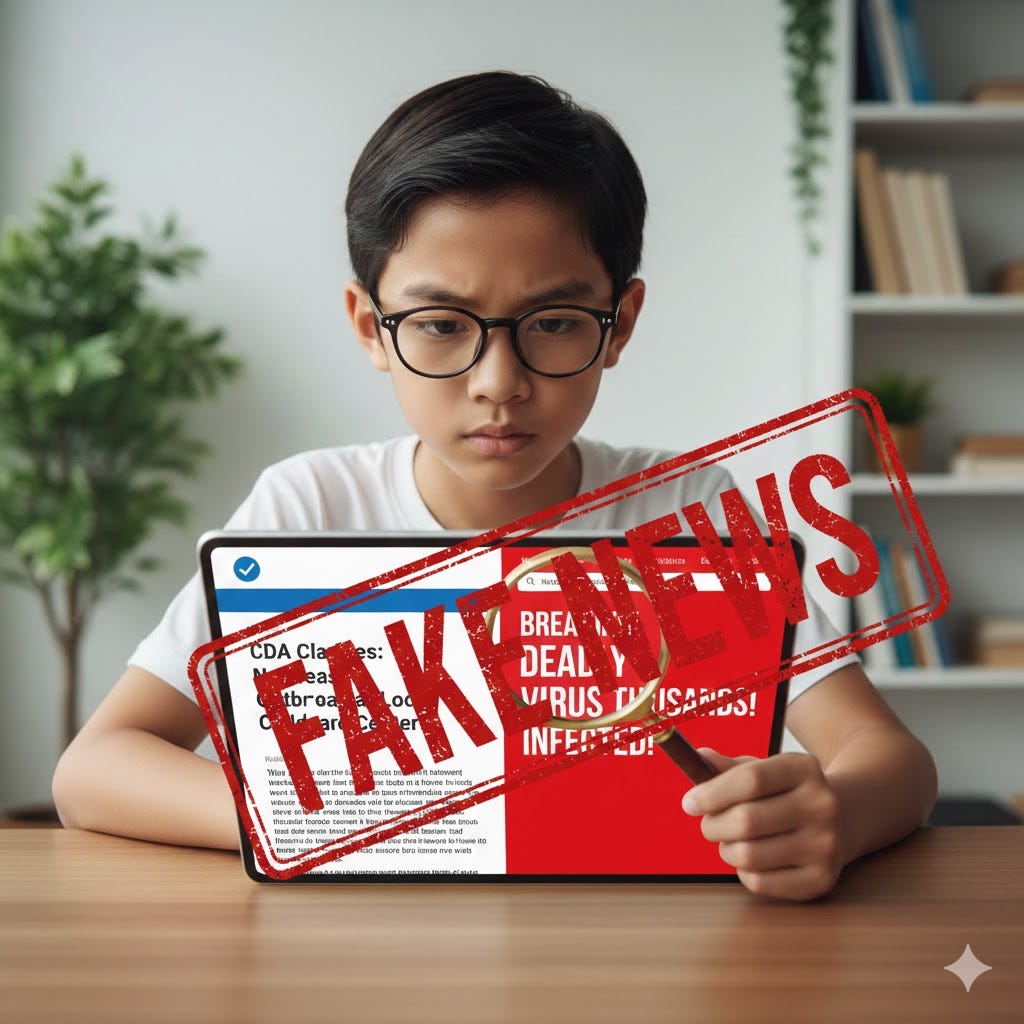
Question 1: Visual Stimulus
“Look at the picture. Why is the student using a magnifying glass, and what lesson can we learn from this?”
O (Opinion): I believe the student is using a magnifying glass to symbolize the need for deep “investigation” and careful checking before believing what we read online.
R (Reason): Many fake news articles are designed to look almost identical to real ones to trick us. By looking closely, the student is trying to find “scam signs” like spelling errors or suspicious links.
E (Example/Experience): I’ve seen WhatsApp messages claiming that certain foods are “poisonous.” My mother always inculcates in me the rule to never “share first, think later.” She taught me to use the “S.U.R.E.” method—Source, Understand, Research, and Evaluate—to check facts. This gives me a deep sense of reassurance that I am not spreading lies.
O (Opinion Restated): Thus, being as meticulous as the student in the picture is a wise choice that protects us and our families.
Question 2: Personal Opinion
“Have you ever received a message that turned out to be fake? How did it make you feel?”
O (Opinion): Yes, I have received fake “voting” links on WhatsApp, and it made me feel very concerned about how easily people can be deceived.
R (Reason): Scammers often use “fake news” about contests or emergencies to create a sense of urgency, hoping we will click a link without thinking.
E (Example/Experience): Just last week, a contact sent me a link to “vote for a friend’s child” in a dance competition. I was about to click it, but I remembered a police advisory about WhatsApp account takeovers. I had to byte the bullet and tell my friend that her account might have been hacked.
O (Opinion Restated): Because I chose to stay calm and verify the information, I avoided a potential scam and helped alert others.
Question 3: Solution-Based
“What more can be done to help the elderly, who are often the most targeted by fake news, stay safe online?”
O (Opinion): I think we need more regular “digital clinics” at Community Clubs where youths can teach seniors how to identify deepfakes and fake news.
R (Reason): Many seniors did not grow up with technology and may not realize that a video of a CEO’s face can be completely faked by AI.
E (Example/Experience): I often help my grandfather check his Telegram messages. Instead of just doing it for him, I explain why a message looks fake, like pointing out that official government bodies never ask for money or OTPs over the phone. If every grandchild did this, we would forge a strong sense of camaraderie and safety in our families.
O (Opinion Restated): By being proactive in educating our pioneers, we can ensure that Singapore remains a resilient and informed Smart Nation.
Good for reading…………
Theme: Media Literacy / Civic Responsibility / Technology Visual Stimulus: A drawing of a student looking at two similar-looking news articles on a tablet. One is from a verified news site with a “check” mark, and the other is from a suspicious website with a flashy, “clickbait” headline. The student is holding a magnifying glass over the suspicious headline.
📖 Vocabulary List
Discerning (Adjective): Having or showing good judgment.
Sensational (Adjective): (Of an event, a person, or a piece of information) causing great public interest and excitement, often at the expense of accuracy.
Verification (Noun): The process of establishing the truth, accuracy, or validity of something.
Meticulous (Adjective): Showing great attention to detail; very careful and precise.
Resilient (Adjective): Able to withstand or recover quickly from difficult conditions.
🌟 Idiom of the Day
“Take it with a grain of salt”
Meaning: To not completely believe something that you are told because you think it might not be true.
PSLE Oral Usage: “When we read shocking news on social media that isn’t reported on the official news, we must take it with a grain of salt until it is verified.”