
PSLE#31 English Oral – Standing Up, Not Standing By: Tackling School Bullying
PSLEhacker Episode #31 - OREO Method

Date of News Article: 18 February 2026 Source: Adapted from Ministry of Education (MOE) Guidelines & School Safety Reports
Reading Passage:
Singapore schools have always maintained a zero-tolerance policy towards bullying. However, as students spend more time online, bullying has evolved from physical hair-pulling or name-calling in the canteen to “cyberbullying”—the use of social media or messaging apps to exclude, harass, or spread rumors about others. Unlike traditional bullying, cyberbullying can happen at any time and often feels impossible to escape.
Recent studies show that the “Bystander Effect” is one of the biggest hurdles in stopping these behaviors. Often, students witness bullying but remain silent because they fear becoming the next target or believe it is “none of their business.” To counter this, schools are now focusing on “Upstander” training. An Upstander is someone who recognizes when something is wrong and acts to make it right, whether by supporting the victim or reporting the incident to a trusted adult.
Education Minister Chan Chun Sing recently emphasized that character building is just as important as academic grades. Schools are encouraged to inculcate values of kindness and mutual respect through Peer Support Leader programs. By fostering a culture where students look out for one another, we create a safe learning environment for all.
Ultimately, preventing bullying is a collective responsibility. When students make the meaningful and wise choice to speak up against injustice, they do their part in building a gracious society. Being proactive in defending a peer is not just about stopping a fight; it is about protecting the heart and soul of our school community.
Word Count: 285 words
PSLE Oral Practice: Stimulus-Based Conversation (OREO Method)
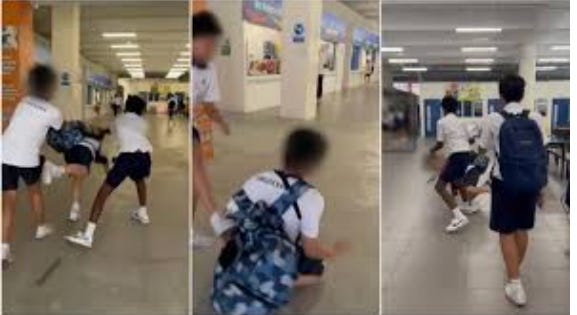
Question 1: Visual Description & Analysis
“Look at the picture. Describe what is happening and how the environment affects the victim.”
O (Opinion): It is deeply distressing to see that a student is being subjected to physical harassment by his peers, which clearly violates the school’s zero-tolerance policy towards bullying.
R (Reason): The bullies are using physical force to trip and push the victim, likely causing him to feel a deep sense of panic and isolation. In the background, there are other students who seem to be walking away, which highlights the “Bystander Effect” where people remain silent instead of becoming an “Upstander”.
E (Experience): In my school, we often discuss how such injustice can leave long-lasting emotional scars. My teachers always inculcate the value of looking out for one another. I remember a time a friend was being teased; I made a proactive choice to report it to a teacher immediately to ensure my friend felt safe.
O (Opinion Restated): Therefore, the scene in the picture serves as a stark reminder that we must all do our part to stop such harmful behavior before it escalates.
Question 2: Personal Opinion & Moral Judgment
“What do you think is the most effective way to help someone who is being bullied in school?”
O (Opinion): I believe the most effective way to help is to provide immediate emotional support to the victim and then safely report the incident to a trusted adult.
R (Reason): Victims often feel too intimidated to speak up for themselves. By standing by them, we give them a deep sense of reassurance that they are not alone. Reporting is not “snitching”; it is a meaningful and wise choice to protect a peer from further harassment.
E (Experience): Our school has a Peer Support Leader program where we are trained to spot signs of distress. I once noticed a classmate sitting alone and looking sad after a group project. I put myself in his shoes and realized he felt excluded. I invited him to join my group for lunch, which helped forge a strong sense of camaraderie.
O (Opinion Restated): Ultimately, being a supportive friend is an indispensable part of creating a kind and gracious school community.
Question 3: Solution-Based (Higher Order Thinking)
“Should schools focus more on punishing bullies or on educating them through ‘Restorative Justice’?”
O (Opinion): I think a balanced approach is best, but I strongly believe in Restorative Justice to help bullies understand the pain they have caused.
R (Reason): While punishments are a deterrent, they don’t always change a bully’s heart. Education helps them develop empathy. If a bully has to face their victim and hear how their actions were detrimental to the victim’s well-being, they are less likely to repeat the mistake.
E (Experience): We once had a workshop where we role-played different scenarios. I had to play the victim, and it was a very eye-opening experience. It helped us all realize that our words and actions have weight. By being proactive in teaching empathy, schools can stop bullying at the root.
O (Opinion Restated): Making the meaningful and wise choice to educate students about kindness is the only way to weather the storm of bullying in the long run.
Visual Stimulus: A series of frames showing a student being physically pushed and tripped by peers in a school hallway while another student walks by in the background.
🌟 Key Vocabulary to use for this topic:
Zero-tolerance: Refusing to accept any level of bad behavior.
Upstander: Someone who acts to stop bullying (instead of just watching).
Injustice: An unfair situation or action.
Restorative Justice: A system that focuses on repairing the harm caused by bad behavior rather than just punishing it.
🌟 Idiom of the Day
“Put yourself in someone else’s shoes”
Meaning: To imagine what it would be like to be in someone else’s situation.
PSLE Oral Usage: “Before we say something mean online, we should put ourselves in their shoes to understand how much our words might hurt them.”