
PLSE#26 English Oral- Staying Alert: Protecting Our Families from Scams
PSLEhacker Episode #26 - TREE Method

Date of News Article: 2 February 2026 (Based on announcements regarding Singapore banks strengthening authentication against scams) Source: Adapted from The Straits Times & Fintech News Singapore (Crime & Cyber Security)
Reading Passage:
As Singapore progresses towards becoming a fully digitalised Smart Nation, the convenience of online banking has benefited many. However, this digital shift has also brought about a darker side: a sharp rise in cybercrimes. Scammers are using increasingly sophisticated phishing tactics—sending deceptive SMSes or emails pretending to be from local banks or government agencies—to steal personal information and hard-earned savings.
While anyone can fall victim to these deceitful tactics, the elderly are particularly vulnerable. Many seniors may panic when they receive a sudden message claiming that their bank account has been locked. Scammers prey on this fear, rushing their victims into clicking malicious links. Once clicked, the victims are directed to fake websites that look exactly like the real bank login pages, tricking them into giving away their passwords.
To combat this, the authorities and banks are stepping up security. By 2027, banks will completely phase out the use of NRIC numbers for authentication and shift entirely to digital tokens instead of SMS One-Time Passwords (OTPs). The government has also launched the ScamShield app to block known scam numbers. However, official measures are only one part of the solution; family support remains the strongest line of defence.
Youths play a crucial role in this fight. By staying informed about the latest scam trends, students can step up to educate their grandparents and parents. Taking the time to inculcate a habit of skepticism and verifying unknown numbers is a proactive way to protect loved ones. When families communicate openly and make the meaningful and wise choice to pause and check before clicking, they build a strong, united front against cybercriminals.
Word Count: 298 words
PSLE Oral Practice: Stimulus-Based Conversation (TREE Method)
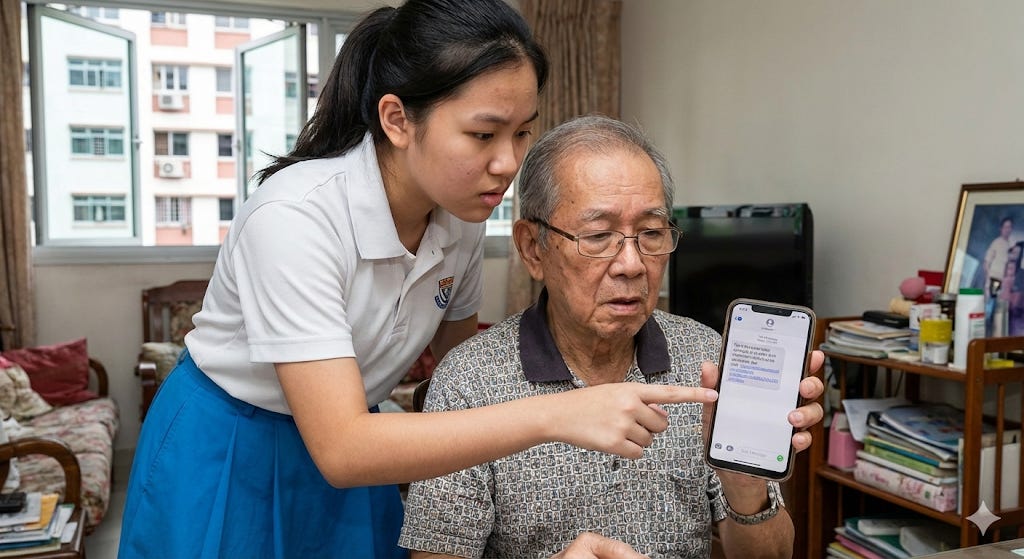
Question 1: Visual Stimulus
“Look at the picture. What is the teenager doing, and why is her action important?”
Thought (T): The teenager is stopping her grandfather from clicking on a suspicious text message and calmly explaining the danger to him.
Reason (R): This action is extremely important because the message is likely a phishing scam. Elderly folks often panic when they receive urgent-sounding messages, and if he had clicked the link, scammers could have easily stolen his banking details or infected his phone with malware.
Experience (E): In my own home, I often help my grandmother check her messages because her eyesight is poor and she isn’t very familiar with technology. Whenever I help her block a scam number or install the ScamShield app, it gives me a deep sense of accomplishment knowing I kept her safe.
Ending (E): Therefore, younger family members stepping in to assist the elderly is a wise choice that protects the family’s hard-earned savings.
Question 2: Personal Opinion
“Have you or anyone in your family ever encountered a scam message or call? How did you react?”
Thought (T): Yes, my family receives scam messages and calls quite frequently.
Reason (R): Scammers often use automated systems to send out thousands of fake messages, hoping someone will be careless enough to fall for them. They often pretend to be from delivery companies, telecommunications providers, or the police.
Experience (E): Just last week, my mother received an automated phone call claiming she had an unpaid parcel fee. She immediately knew it was suspicious, so she hung up the phone and checked her actual shopping app, which showed no such fees. She inculcated in me the rule that we must never give out our personal details or OTPs over the phone. Dealing with this together helps forge a strong sense of camaraderie and vigilance in our family.
Ending (E): By remaining calm and proactive in verifying information, we ensure that we do not become victims of such crimes.
Question 3: Solution-Based
“Besides relying on family members, what else can the government or community do to protect the elderly from falling victim to scams?”
Thought (T): The community can organize more educational workshops, and the government must continue working with banks and telcos to block scams at the source.
Reason (R): Not all elderly folks live with younger family members who can help them. They need independent knowledge and systemic protection to stay safe in the digital world.
Experience (E): For example, Community Centres could host “Digital Defense” talks specifically tailored for seniors, using dialects so they fully understand the dangers. Additionally, it is great that banks are phasing out the use of SMS OTPs, as these are easily stolen by scammers.
Ending (E): If everyone does their part—from the banks upgrading their security to grassroots volunteers educating the seniors—we can create a much safer digital environment for our pioneers.
Pleasure reading……………….
Theme: Cyber Wellness / Family Responsibility / Vigilance Visual Stimulus: A photo taken in an HDB living room. An elderly grandfather looks worried as he holds up his smartphone, showing a text message with a suspicious link. A teenage girl in a school uniform is sitting beside him, placing her hand gently over his to stop him from clicking the screen, while explaining something calmly to him.
📖 Vocabulary List
Deceptive (Adjective): Giving an appearance or impression different from the true one; misleading.
Phishing (Noun): The fraudulent practice of sending emails or messages purporting to be from reputable companies in order to induce individuals to reveal personal information.
Authentication (Noun): The process or action of proving or showing something to be true, genuine, or valid (like verifying your identity to a bank).
Skepticism (Noun): A doubting or questioning attitude or state of mind.
Prey (Verb): Take advantage of or exploit (someone).
🌟 Idiom of the Day
“Too good to be true”
Meaning: Something that appears so positive or advantageous that it is hard to believe, and is usually a trick or scam.
PSLE Oral Usage: “When we see an online advertisement selling an expensive phone for only ten dollars, we must be careful because it is usually too good to be true.”