
PSLE#2 English Oral - Graciousness or Messiness? The Tray Return Challenge
PSLEhacker #2 - PEEL Method

(A) Reading Aloud :
Date of News Article: 6 February 2026 Source: Adapted from The Straits Times / Stomp Singapore
Singapore has made great strides in promoting social responsibility, with over ninety percent of diners now returning their own trays and crockery at hawker centres. However, a new challenge has emerged that threatens the success of this initiative. Recent reports have highlighted several popular dining hubs, such as Hong Lim Market and Albert Food Centre, where tray return stations have become “unhygienic and messy” due to overcrowding.
During peak lunch hours, photos shared online showed return racks so full that trays were being left on the floor, on top of waste bins, and even balanced precariously on nearby seats. Stomper Tan, a frequent diner, described the scene as “distressing,” noting that the lack of space often forces even the most civic-minded patrons to leave their dirty dishes on the tables.
The National Environment Agency (NEA) is actively monitoring these “hotspots” and working with cleaning contractors to adjust manpower deployment. One proposed solution is to implement larger, partitioned shelves to help diners sort their utensils more effectively.
Ultimately, maintaining a pleasant dining environment requires a “shared effort” between the government, cleaning contractors, and the public. While diners play their part by clearing their mess, operators must ensure that return stations are cleared promptly so that the cycle of cleanliness is not broken. As we move towards a self-service culture, we must remember that a clean table is not just about avoiding a fine—it is about showing empathy for the next person waiting to eat.
Word Count: 248 words
(B) Stimulus-Based Conversation (SBC):
Q & A Time :
Question 1: Visual Stimulus
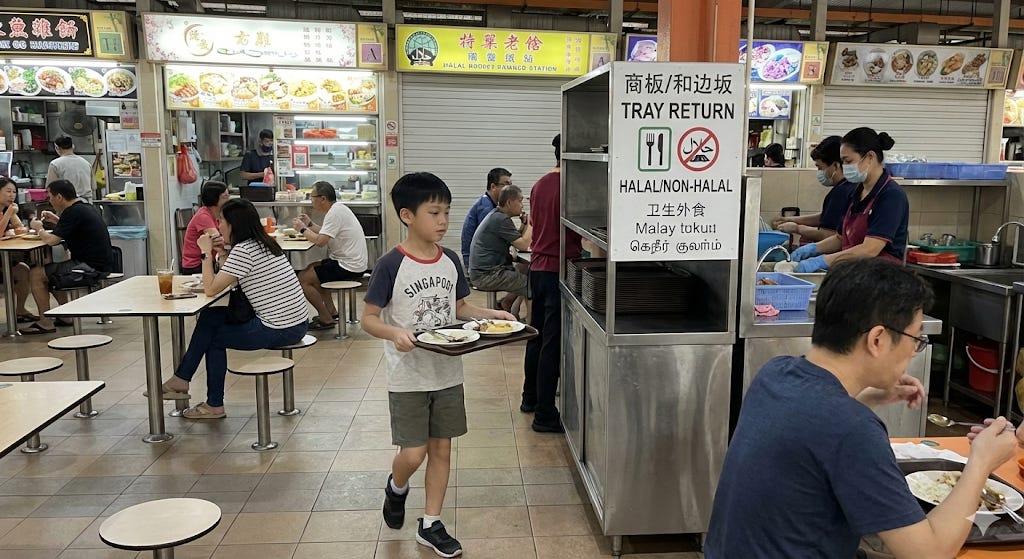
“Look at the picture. Would you do what the boy in the picture is doing after a meal at a hawker centre? Why or why not?”
Point: Yes, I would definitely clear my table and return my tray after a meal.
Explanation: I believe it is a basic act of civic-mindedness and social responsibility. By doing so, we ensure that the tables are clean for the next diner, and we significantly reduce the workload of the cleaners, who are often elderly and have to be on their feet all day.
Example/Experience: Whenever my family and I dine at our neighbourhood hawker centre, my parents always remind me to do this. Initially, I felt it was a chore, but I soon developed a sense of responsibility and involvement. Now, when I return my tray and the cleaning auntie gives me a supportive smile and gentle gaze of reassurance, it truly feels like a mutually rewarding experience.
Link: Therefore, I would certainly return my tray to play my part in keeping the hawker centre clean.
Question 2: Personal Experience
“Tell me about a time when you or someone you know showed consideration for others in a public place.”
Point: A memorable incident happened last month when I was taking the MRT train home with my mother.
Explanation: Showing consideration in public spaces, such as giving up a seat, is crucial because it ensures the safety and comfort of those who need it more than we do.
Example/Experience: The train was heavily crowded, but we were lucky to get seats. Suddenly, an elderly lady with a walking stick boarded the train. Without hesitation, I stood up and offered her my seat. She beamed with a supportive smile and thanked me profusely. Seeing her comfortable gave me a deep sense of pride and fulfilment. My mother also looked at me, radiating pride and contentment for doing the right thing.
Link: That experience taught me that a simple act of consideration can make a huge difference to someone else in a public place.
Question 3: Broader Opinion
“Some people say that it is solely the cleaners’ job to keep public eating places clean. Do you agree? Why or why not?”
Point: I strongly disagree with the statement that it is solely the cleaners’ job to maintain cleanliness in public eating places.
Explanation: While cleaners are employed to maintain hygiene, keeping our shared spaces clean is a collective responsibility. Relying entirely on them is unfair and unsustainable, especially during peak lunch hours when the crowd is overwhelming. (Note: This uses the “Negative to positive response” technique from the book!)
Example/Experience: If everyone leaves their dirty dishes behind, the environment quickly becomes unhygienic and attracts pests, ruining the dining experience for everyone. Instead of having a dismissive attitude, we should cultivate a sense of responsibility and compassion for the workers. By taking just a minute to clear our own mess, we help to create a fun and supportive environment for both diners and cleaners alike.
Link: Hence, I firmly believe that keeping our public eating places clean is a shared duty, and not just the job of the cleaners.
Go through below > when you have spare time ………….
PSLE Oral Practice Corner (PEEL Format)
Question: “Some people say that returning trays is useless if the return racks are always full. What is your opinion?”
Point: I do not believe that returning trays is useless, even if the racks are full. I think we should still try our best to be responsible diners.
Explain: While it is frustrating when a rack is full, leaving a tray on the table makes it much harder for the next person to find a seat. It also attracts birds and pests, which is very unhygienic.
Example: For instance, if I encounter a full rack, I will look for another return station nearby instead of giving up. If all the racks are full, I will stack my tray neatly at the side of the station as a last resort, rather than leaving it in the middle of a dining table.
Link: Therefore, I feel that we must stay committed to this good habit so that we can collectively maintain a clean and pleasant environment for everyone.
🌟 High-Scoring Idioms & Vocab to Note
“Made great strides” (Vocabulary) – To make significant progress.
Usage: “Singapore has made great strides in its journey to become a zero-waste nation.”
“At the end of one’s tether” (Idiom) – To be so tired or frustrated that you feel you cannot deal with a situation anymore.
Usage: “The elderly cleaners were at the end of their tether trying to clear the overflowing return racks during the busy lunch hour.”
“A shared effort” (Phrase) – Something that requires everyone to work together.
Usage: “Keeping our hawker centres clean is a shared effort between diners and cleaners.”
“Move the needle” (Idiom) – To make a noticeable difference in a situation.
Usage: “The new tray-return rules have finally begun to move the needle regarding public cleanliness.”
Learning Vocabs :
Civic-mindedness / Social responsibility:
Crockery and utensils:
Tray return station / Designated rack:
Hygiene / Sanitation:
Unsung heroes:
Cultivate / Inculcate:
Alleviate / Lighten:
Deposit:
Sanitise:
Considerate / Empathetic:
Bustling:
Unhygienic / Unsightly:
Laborious:
“Sense of responsibility and compassion”:
“Mutually rewarding experience”:
“Supportive smile and gentle gaze of reassurance”:
“Take for granted”:
“Lead by example”: