
PSLE#6 English Oral - Bridging the Gap: Youth "Digital Doctors"
PSLEhacker Episode 6 - PEEL Method

Date of News Article: 15 February 2026 Source: Adapted from The Straits Times (Community & Youth)
Reading Passage:
In our rapidly advancing Smart Nation, simple tasks like booking a doctor’s appointment or scanning a QR code to pay for chicken rice can be a daunting challenge for the elderly. To tackle this, a new wave of youth volunteers, nicknamed “Digital Doctors,” has been making rounds at community clubs and senior activity centres across Singapore.
These volunteers, mostly secondary school and junior college students, spend their Saturday mornings patiently guiding seniors through the functions of their smartphones. From setting up banking apps to identifying potential “scam” messages, these young mentors are helping to ensure that no one is left behind in the digital race.
The National Silver Academy recently reported that since the launch of this peer-led initiative, the digital literacy rate among seniors has improved significantly. However, the program is about more than just technology; it is about building bridges between generations. For many seniors who live alone, these weekly sessions are a vital source of social interaction and mental stimulation.
Organizers emphasize that “patience is the key ingredient” in this social recipe. Volunteers are trained to use simple analogies and avoid technical jargon that might confuse the elderly. In return, the students gain a deeper understanding of the challenges faced by the pioneer generation, fostering a culture of empathy and respect.
As Singapore continues to digitalize, such community-led efforts are essential. By sharing just a few hours of their time, these youth volunteers are not only teaching tech skills but are also weaving a stronger, more inclusive social fabric. It is a heartwarming reminder that while technology may change, the human need for connection and compassion remains constant.
Word Count: 305 words
(B) Stimulus-Based Conversation (SBC):
Q & A Time :
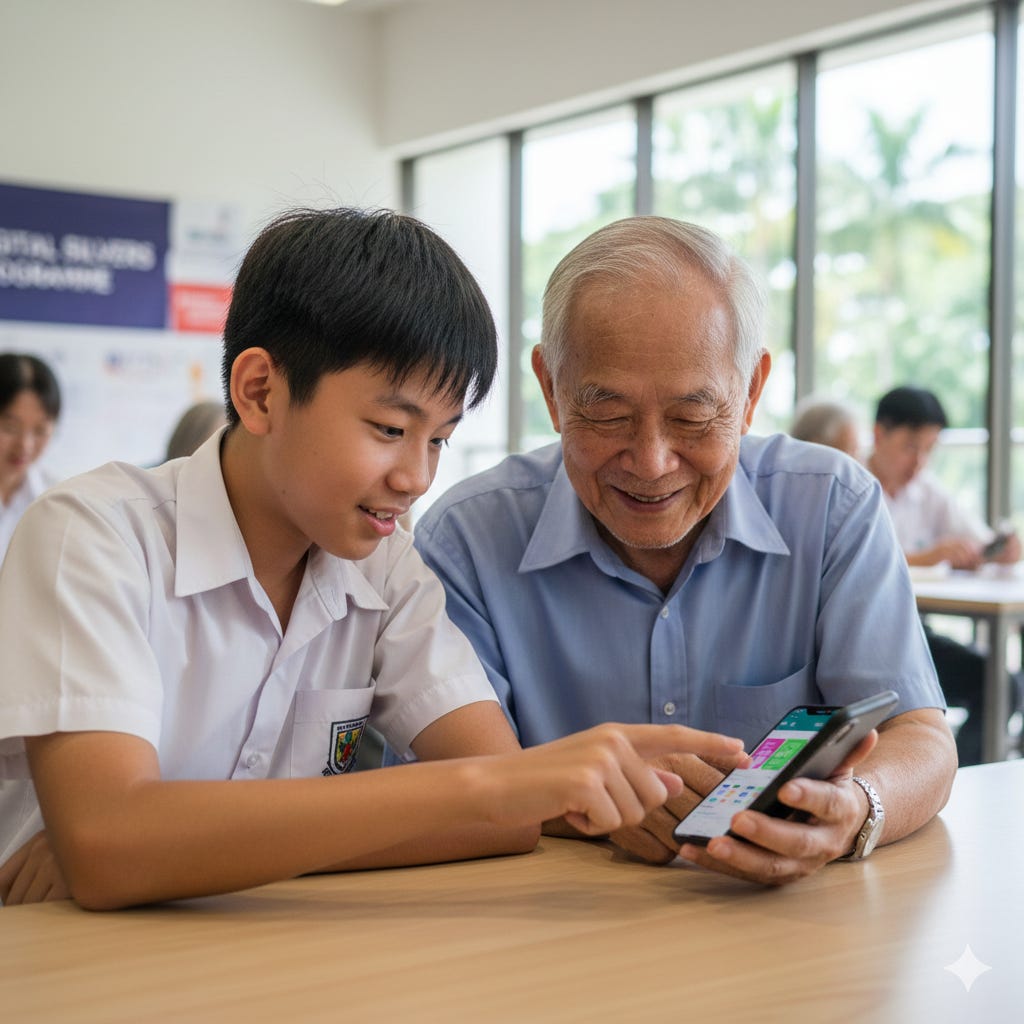
Question 1: Visual Stimulus
“Look at the picture. Why do you think the boy is helping the elderly man with his phone?”
Point: I believe the boy is helping the elderly man to ensure he feels confident and included in our digital society.
Explanation: Many seniors find new technology overwhelming. By offering his time, the boy is alleviating the man’s anxiety and helping him stay connected with his family or access essential services.
Example/Experience: The elderly man has a supportive smile and a gentle gaze of reassurance toward the boy. It reminds me of when I taught my own grandmother how to use video calls. At first, she was at the end of her tether with the app, but once she saw my face on the screen, her face was aglow with an encouraging smile.
Link: Therefore, the boy is acting as a “Digital Doctor” to foster a mutually rewarding experience for both of them.
Question 2: Personal Experience
“Have you ever volunteered your time to help others? Tell me about it.”
Point: Yes, I recently volunteered at a local food bank to help pack essential items for low-income families.
Explanation: I wanted to play my part in supporting the vulnerable members of our community. I realized that even a small effort can move the needle in making someone’s life a little easier.
Example/Experience: While packing the bags, I was deeply engrossed in my task. Even though the work was a bit laborious, I felt a deep sense of accomplishment and pride when I saw the neatly stacked rows of supplies. The experience helped me forge a sense of camaraderie with the other student volunteers.
Link: That experience taught me that giving back to society is one of the most meaningful and fun-filled ways to spend my school holidays.
Question 3: Broader Opinion
“Do you think it is the government’s responsibility or the younger generation’s duty to help seniors keep up with technology?”
Point: I believe it is a shared responsibility between the government and the younger generation.
Explanation: While the government can provide the infrastructure, such as building community centres and providing affordable data plans, it is the younger generation that can provide the “human touch.” Technology can be intimidating, and having a patient youth volunteer makes the learning process much less daunting.
Example/Experience: For example, my school often organizes values-in-action (VIA) programs where we visit elderly homes. I realized that while the seniors have the gadgets, they often lack the confidence to use them. When we sit with them, we inculcate a sense of curiosity in them. By sharing our time, we kill two birds with one stone: the seniors learn a new skill, and we forge a strong sense of camaraderie and compassion for our elders.
Link: Therefore, I feel that when the government and youth work together, we can truly build an inclusive society where no one is left behind.
During free time to read…………..
Theme: Community Spirit / Volunteering Visual Stimulus: A photo of a young boy in a school uniform sitting beside an elderly man. The boy is pointing at a smartphone screen, and both are smiling warmly.
📖 Vocabulary List
Daunting (Adjective): Seeming difficult to deal with in anticipation; intimidating.
Digital Literacy (Noun): The ability to find, evaluate, and communicate information through various digital platforms.
Analogy (Noun): A comparison between two things, typically for the purpose of explanation or clarification.
Pioneer Generation (Noun): Referring to the early builders of Singapore (born in 1949 or earlier).
Inclusive (Adjective): Including everyone; not leaving anyone out.
🌟 Idiom of the Day
“Lend a helping hand”
Meaning: To assist or help someone with something.
PSLE Oral Usage: “We should always be ready to lend a helping hand to the elderly, whether it is helping them cross the road or teaching them how to use an app.”