
PSLE#5 English Oral - Sweet Enough? Choosing Healthier Sips
PSLEhacker Episode #5 - PEEL Method

(A) Reading Aloud :
Date of News Article: 12 February 2026 Source: Adapted from The Straits Times (Health & Lifestyle)
Walking through any supermarket or hawker centre in Singapore today, you will notice colorful labels marked ‘A’, ‘B’, ‘C’, or ‘D’ on drink bottles and even bubble tea menus. These are Nutri-Grade labels, a key part of Singapore’s war on diabetes. Starting this year, the government has expanded these labels to include even more types of beverages, ensuring that consumers are well-informed about the sugar and saturated fat content in their favorite sips.
Recent data from the Ministry of Health shows that these labels are working. More Singaporeans are now “voting with their wallets” and choosing drinks graded ‘A’ or ‘B’. These healthier options contain little to no sugar and are free from artificial sweeteners. Consequently, many beverage manufacturers have reformulated their recipes to reduce sugar, helping to lower the average sugar intake across the population.
Health experts emphasize that small changes in our daily habits can lead to significant long-term benefits. Excessive sugar consumption is linked to various health issues, including tooth decay and obesity. By opting for a “siew dai” (less sugar) or “kosong” (no sugar) version of our local coffee or tea, we can significantly reduce our daily calorie count.
Schools are also playing a vital role by educating students on how to read these labels effectively. During recess, students are encouraged to choose plain water or lower-sugar drinks to keep their energy levels stable throughout the day. While the occasional sweet treat is fine, the goal is to cultivate a “health-first” mindset. After all, our health is our greatest wealth, and a sustainable lifestyle begins with the choices we make at the drink stall.
Word Count: 285 words
(B) Stimulus-Based Conversation (SBC):
Q&A Time :
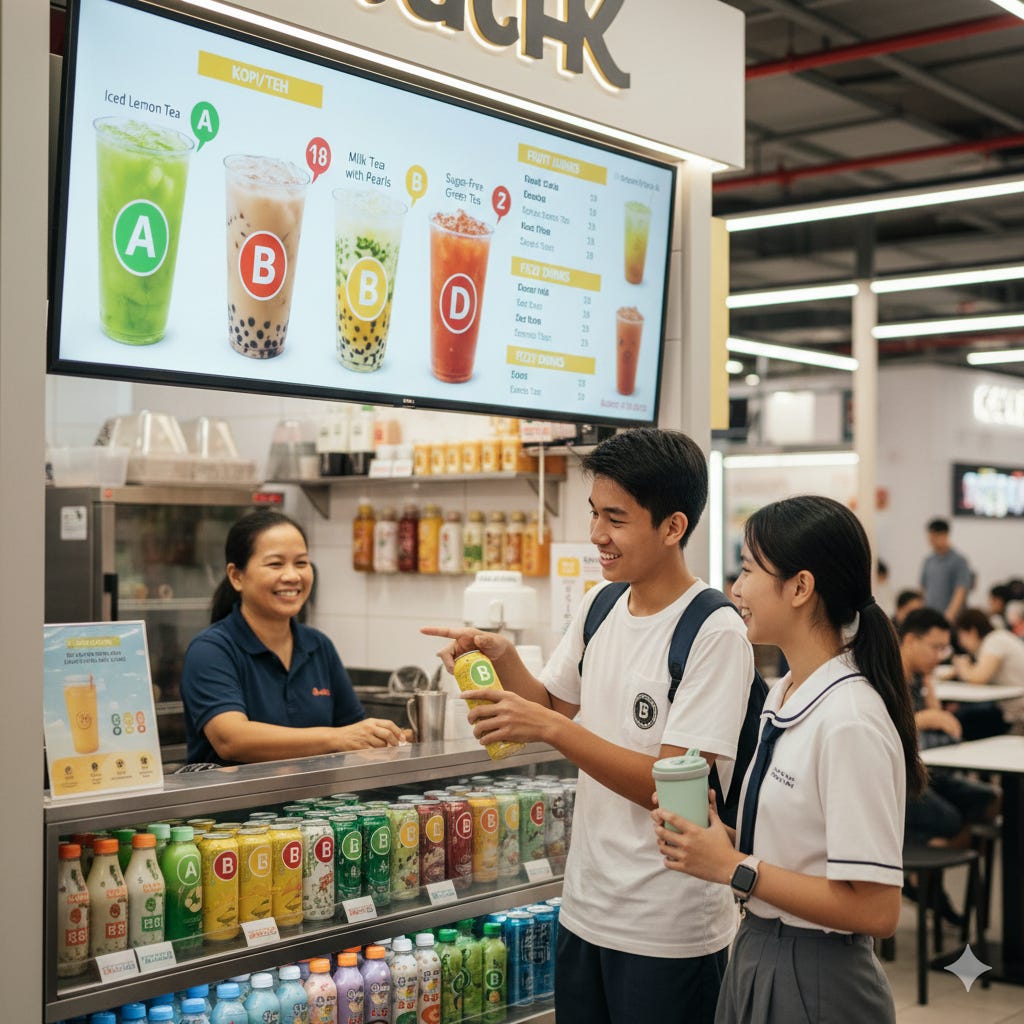
Question 1 : “Look at the picture. If you were the student, would you choose the drink with the ‘B’ label? Why or why not?”
Point: Yes, I would definitely choose the drink with the ‘B’ label over one with a ‘C’ or ‘D’ grade.
Explanation: I am very environmentally-conscious of my own body and health. Choosing a drink with less sugar means I can avoid the “sugar crash” that makes me feel tired during Science or Math lessons. It is a simple way to play my part in staying healthy.
Example/Experience: For instance, my parents have inculcated the habit of checking labels since I was young. Last week, when we went for a celebration, I chose a plain sparkling water instead of a fizzy soda. I felt a deep sense of accomplishment and pride because I stayed committed to my goal of eating less sugar.
Link: Therefore, I believe choosing a healthier grade is a meaningful and wise choice for anyone who wants to stay fit and active.
Question 2: Personal Choice & Influence
“Do you think advertisements for bubble tea and sugary snacks make it harder for students to stay healthy? Why?”
Point: Yes, I firmly believe that pervasive advertisements make it significantly more challenging for students to make healthy choices.
Explanation: Many of these advertisements use vibrant colors and celebrity endorsements to create a “Fear of Missing Out” or FOMO. When we see our favorite influencers holding a sugary drink, it creates a powerful temptation that can override our logical knowledge about health.
Example/Experience: For instance, during the school holidays, my social media feed was flooded with ads for a new “limited edition” brown sugar milk tea. I felt a sense of vulnerability and almost bought it, even though I knew it was graded ‘D’. However, I remembered my Science teacher’s lesson on sugar and decided to ‘byte the bullet’ by choosing a plain fruit tea instead.
Link: Therefore, while ads are a major distraction, we must cultivate the self-discipline to look past the “bells and whistles” and prioritize our well-being.
Question 3: Role of the Community
“Apart from Nutri-Grade labels, what else can be done to encourage Singaporeans to lead a healthier lifestyle?”
Point: I believe that organizing more community-based fitness activities would be a fantastic way to complement the food labels.
Explanation: While labels help us choose better food, staying healthy also requires physical activity. When the community comes together for a common goal, it creates an atmosphere of exhilaration and purpose, making exercise feel less like a chore and more like a fun social event.
Example/Experience: For example, my neighborhood recently started a “Sunday Family Walk” at the local park. My parents and I joined in, and I was filled with eager curiosity to see so many neighbors participating. This activity helped to forge a strong sense of camaraderie while ensuring we stayed active together.
Link: Hence, I feel that a combination of clear health information and active community support is the best way to move the needle toward a healthier Singapore.
Reading during your spare time …………………
Theme: Health & Food Hygiene Visual Stimulus: A photo of a student standing in front of a drink stall, pointing at a Nutri-Grade ‘B’ label on a green tea bottle while a friend looks on.
📖 Vocabulary List
Reformulate (Verb): To change the ingredients or “recipe” of a product to make it better or healthier.
Consumption (Noun): The act of eating, drinking, or using something.
Saturated Fat (Noun): A type of fat that is unhealthy if you eat too much of it.
Reformulated (Adjective): Describing something that has been improved (e.g., “The reformulated soda has 50% less sugar.”)
Vital (Adjective): Absolutely necessary or important; essential.
Reform (Verb): To make changes in something in order to improve it.
🌟 Idiom of the Day
“Health is Wealth”
Meaning: Being healthy is more valuable than having a lot of money or toys, because without health, you cannot enjoy anything else.
PSLE Oral Usage: “My grandmother always says that health is wealth, which is why we always return our trays and choose ‘less sugar’ drinks at the hawker centre.”