
PSLE#4 English Oral - Out of Sight, Into the Locker: The New School Norm
PSLEhacker Episode #4 - PEEL Method

(A) Reading Aloud :
Date of News Article: 25 January 2026 Source: Adapted from The Straits Times (Parenting & Education Section)
Reading Passage:
As the school bell rang at 7:30 a.m. this past Monday, students at Cedar Girls’ Secondary and St Gabriel’s Secondary began a new daily ritual. Instead of slipping their smartphones into their pockets, they queued up at long rows of metal cabinets to secure their devices in dedicated mobile phone lockers. This scene is becoming a common sight across nearly ten secondary schools that have recently installed these “handphone hotels”.
The shift follows tightened guidelines announced by the Ministry of Education (MOE) in late 2025. Starting from January 2026, secondary school students are no longer allowed to use their smartphones or smartwatches during the entire school day. This strict ban extends beyond the classroom to include recess, periods between lessons, and even co-curricular activities (CCAs).
MOE’s enhanced measures aim to reduce digital distractions and cultivate healthier screen habits. Recent studies have shown that the mere presence of a phone nearby, even if switched off, can affect a student’s cognitive ability to process information. By keeping devices in lockers rather than school bags, schools hope to “rebalance” the time students spend online versus face-to-face interaction.
While some students initially greeted the policy with “moans and groans,” many are already seeing the silver lining. During recess, school foyers and canteens have become more socially vibrant. Instead of sitting in silence with their eyes glued to screens, students are now actively conversing, playing basketball, or forming interest groups.
Teachers have also reported positive outcomes, noting that the school environment has become more focused. As one student shared, “I don’t just hear my friends ranting on social media stories anymore; I actually get to hear them tell the story in person.” Ultimately, the goal is to protect school time as “protected time,” allowing students to truly connect with one another.
Word Count: 312 words
(B) Stimulus-Based Conversation (SBC):
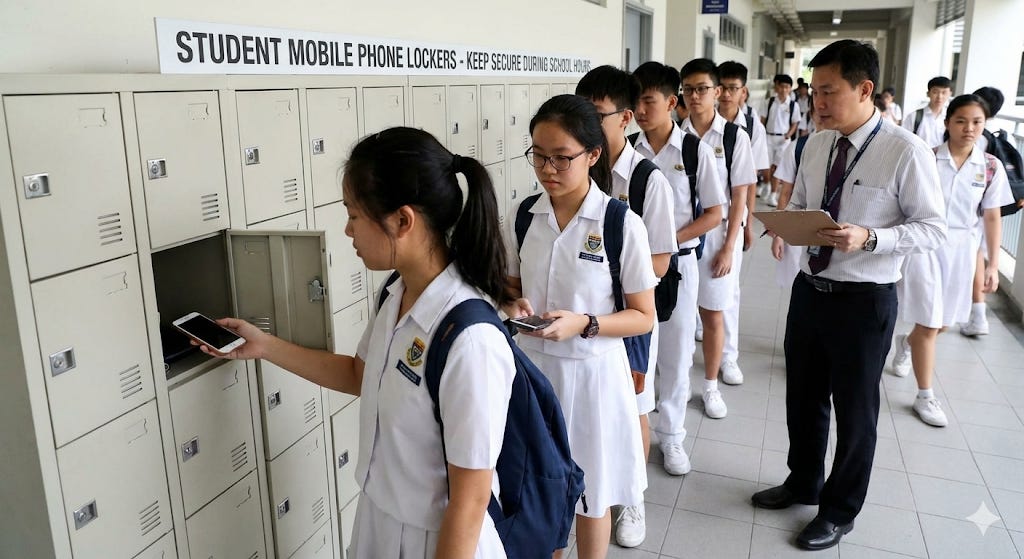
Q & A Time :
Question 1: Visual Stimulus
“Look at the picture. How do you think the students feel about locking their phones away before school starts?”
Point: I believe the students likely have mixed feelings, ranging from a sense of apprehension to a quiet realisation of the benefits.
Explanation: On one hand, some may feel a sense of vulnerability because they are so used to having their devices at their fingertips. On the other hand, others might feel a sense of relief as they are no longer pressured to check social media notifications constantly.
Example/Experience: For instance, the girl in the front of the queue has a face that is a picture of concentration. She isn’t complaining; she is simply following the new routine. I remember when my cousin’s school started this; he said he initially felt “lost,” but soon found himself deeply engrossed in his tasks during lessons because there were no buzzing distractions in his pocket.
Link: Therefore, while it is a major adjustment, many students likely feel that this practice helps them stay focused and disciplined.
Question 2: Broader Opinion
“Do you agree that ‘handphone hotels’ or lockers help to improve student friendships in school? Why?”
Point: I strongly agree that locking phones away helps to forge strong camaraderie and lasting friendships.
Explanation: When students have their eyes glued to their screens during recess, they miss out on the chance to talk to those around them. By removing the digital barrier, students are forced to interact face-to-face, which builds empathy and better communication skills.
Example/Experience: In my own school experience, the most memorable and fun-filled moments happen during recess when we are laughing and chatting over a meal. If everyone were on their phones, the canteen would be silent and lonely. Instead, it is usually buzzing with exhilaration as we share stories about our day.
Link: Hence, I believe that disconnecting from the virtual world allows us to truly connect in the real world, leading to more meaningful and supportive friendships.
Reading when you got extra time …………..
Theme: School Life & Technology Visual Stimulus: A photo of a long queue of students at a secondary school hallway, carefully placing their smartphones into individual metal lockers while a teacher supervises.
🌟 Idiom of the Day
“Out of sight, out of mind”
Meaning: If you do not see something, you don’t think about it or worry about it.
PSLE Oral Usage: “I find that when my phone is in the locker, it is out of sight and out of mind, so I can focus 100% on my Science experiment without being tempted to check my messages.”
PSLE Oral Practice: Stimulus-Based Conversation
Theme: School Life & Technology
Visual Stimulus: A photo of a long queue of students at a secondary school hallway, carefully placing their smartphones into individual metal lockers while a teacher supervises.
Question 1: Visual Stimulus
“Look at the picture. How do you think the students feel about locking their phones away before school starts?”
Point: I believe the students likely have mixed feelings, ranging from a sense of apprehension to a quiet realisation of the benefits.
Explanation: On one hand, some may feel a sense of vulnerability because they are so used to having their devices at their fingertips. On the other hand, others might feel a sense of relief as they are no longer pressured to check social media notifications constantly.
Example/Experience: For instance, the girl in the front of the queue has a face that is a picture of concentration. She isn’t complaining; she is simply following the new routine. I remember when my cousin’s school started this; he said he initially felt “lost,” but soon found himself deeply engrossed in his tasks during lessons because there were no buzzing distractions in his pocket.
Link: Therefore, while it is a major adjustment, many students likely feel that this practice helps them stay focused and disciplined.
Question 2: Broader Opinion
“Do you agree that ‘handphone hotels’ or lockers help to improve student friendships in school? Why?”
Point: I strongly agree that locking phones away helps to forge strong camaraderie and lasting friendships.
Explanation: When students have their eyes glued to their screens during recess, they miss out on the chance to talk to those around them. By removing the digital barrier, students are forced to interact face-to-face, which builds empathy and better communication skills.
Example/Experience: In my own school experience, the most memorable and fun-filled moments happen during recess when we are laughing and chatting over a meal. If everyone were on their phones, the canteen would be silent and lonely. Instead, it is usually buzzing with exhilaration as we share stories about our day.
Link: Hence, I believe that disconnecting from the virtual world allows us to truly connect in the real world, leading to more meaningful and supportive friendships.
🌟 Idiom of the Day
“Out of sight, out of mind”
Meaning: If you do not see something, you don’t think about it or worry about it.
PSLE Oral Usage: “I find that when my phone is in the locker, it is out of sight and out of mind, so I can focus 100% on my Science experiment without being tempted to check my messages.”
📖 Vocabulary List: The “Power Words”
Mandatory (Adjective)
Meaning: Required by law or rules; compulsory.
Usage: “The new school policy makes it mandatory for every student to secure their mobile devices before the first bell rings.”
Inculcate (Verb)
Meaning: To teach an idea or habit through persistent instruction.
Usage: “By implementing this rule, the school aims to inculcate a sense of self-discipline and digital mindfulness in the students.”
Distraction (Noun)
Meaning: Something that prevents someone from giving their full attention to a task.
Usage: “Without the constant distraction of social media notifications, the classroom environment has become much more conducive for learning.”
Engrossed (Adjective)
Meaning: Having all one’s attention or interest absorbed by something.
Usage: “I noticed that my classmates were more engrossed in our group discussion once their phones were tucked away in the lockers.”
Camaraderie (Noun)
Meaning: Mutual trust and friendship among people who spend a lot of time together.
Usage: “The absence of screens during recess has helped to forge a stronger sense of camaraderie among the secondary one students.”
Vibrant (Adjective)
Meaning: Full of energy and life; bright and striking.
Usage: “The school canteen has transformed into a vibrant hub of activity, filled with the sounds of laughter and actual conversation.”
Apprehension (Noun)
Meaning: Anxiety or fear that something bad or unpleasant will happen.
Usage: “While there was some initial apprehension about the ban, most students now appreciate the ‘protected time’ away from their screens.”